Columbimorphae Latham, 1790
The second superorder in Columbaves is Columbimorphae. As mentioned before, we see from Figure ED-2 that Stiller et al. (2024) estimate the Otidimorphae and Columbimorphae split happened early in the Paleocene, around 65.8 million years ago.
I follow the arrangment of the orders in Stiller et al. (2024), with the mesites sister to the sandgrouse, and the two together sister to the pigeons and doves. According to Stiller et al.'s point estimates, the splits between all three orders in Otidimorphae happened before 60 mya, with the pigeons and doves splitting from the mesites and sandgrouse about 65.4 mya with the mesites and sandgrouse split occurring about 61.8 mya.
Jarvis et al. (2014), Prum et al. (2015), Kuhl et al. (2021), Stiller et al. (2024) all concur that the mesites are sister to the sandgrouse, and all but Kuhl et al. place the combination sister to the doves and pigeons. Hackett et al. (2008) also considered the three groups a clade, but with a different arrangement. Kuhl et al. (2021) have a different take on Columbimorphae, and included the Cuculiformes as sister to the Columbiformes.
MESITORNITHIFORMES Wetmore 1960
Sharpe had earlier tried to establish such a suborder (Mesitides), but based it on the preoccupied genus name Mesites. I haven't been able to find uses of Mesitornis as a type genus earlier than Wetmore.
Mesitornithidae: Mesites Wetmore, 1960 (1850)
2 genera, 3 species HBW-3
- Subdesert Mesite, Monias benschi
- White-breasted Mesite, Mesitornis variegatus
- Brown Mesite, Mesitornis unicolor
PTEROCLIFORMES Huxley, 1868
Huxley (1868) first separated the sandgrouse as an order, using the name Pteroclomorphae, which modernizes to Pterocliformes.
Pteroclidae: Sandgrouse Bonaparte, 1831
4 genera, 16 species HBW-4
There has been some controversy about how to spell the family name. Although TiF has used Pteroclidae for a long time, back in 2010 both Pteroclidae (Clements, HBW, Sibley-Monroe) and Pteroclididae (AOU, BLI, Howard-Moore, IOC) were in general use, and even Pterocleidae had also been used. Since then, Pteroclidae has won the day. The name indicates it is known for its wing, i.e., “-cles” takes the same meaning as in names such as Heracles. By analogy with Heraclidae/Heracleidae, it would then appear that either Pteroclidae or Pterocleidae would be correct. Most importantly, the first is the form used by Bonaparte when he established the family-group name in 1831 (as the subfamily Pteroclinae), and is used here.
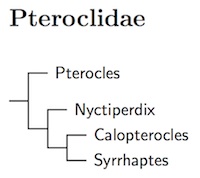
The arrangement here is based on Cohen (2011). There's a bit of ambiguity in Cohen's results. According to the nuclear DNA, the Pin-tailed Sandgrouse, Pterocles alchata, is the basal species. However, mitochondrial DNA puts it sister to Burchell's Sandgrouse, Calopterocles burchelli, albeit with mediocre support. Because of that ambiguity, I've put Burchell's Sandgrouse in its own genus, Calopterocles (Roberts, 1922). Further, Pterocles is now restricted to the Pin-tailed Sandgrouse. Most of the wedge-tailed sandgrouse, with a long 10th primary have been of the former Pterocles species have been moved to Syrrhaptes, which is buried deep inside that clade. The other former Pterocles have been separated as Nyctiperdix (Roberts, 1922, type bicinctus).
 |
| Click for species-level Pteroclidae tree |
|---|
- Pin-tailed Sandgrouse, Pterocles alchata
- Black-faced Sandgrouse, Nyctiperdix decoratus
- Double-banded Sandgrouse, Nyctiperdix bicinctus
- Four-banded Sandgrouse, Nyctiperdix quadricinctus
- Lichtenstein's Sandgrouse, Nyctiperdix lichtensteinii
- Painted Sandgrouse, Nyctiperdix indicus
- Burchell's Sandgrouse, Calopterocles burchelli
- Yellow-throated Sandgrouse, Syrrhaptes gutturalis
- Crowned Sandgrouse, Syrrhaptes coronatus
- Madagascan Sandgrouse, Syrrhaptes personatus
- Spotted Sandgrouse, Syrrhaptes senegallus
- Chestnut-bellied Sandgrouse, Syrrhaptes exustus
- Namaqua Sandgrouse, Syrrhaptes namaqua
- Black-bellied Sandgrouse, Syrrhaptes orientalis
- Tibetan Sandgrouse, Syrrhaptes tibetanus
- Pallas's Sandgrouse, Syrrhaptes paradoxus
COLUMBIFORMES Latham, 1790
Columbidae: Doves, Pigeons Leach, 1819
58 genera, 352 species HBW-4
Following the split of the parrot families, Columbidae is the second-largest non-passerine family, just slightly smaller than the hummingbird family. Prum et al. (2015) and Stiller et al. (2024), both using cafeful calibrations, estimate that this crown-clade is no more than 25 million years old. Kuhl et al. (2021) only includes one species from Columbidae, so there is no estimate from them. In constrast, Oliver et al. (2023) estimate it is about 35 million years old, which I think is probably too old. Even worse is the calibration in Boyd et al. (2022), which looks like something went horribly wrong, yielding a crown-clade age of over 50 million years. The sad truth about calibration is that it is incredibly easy to get wrong.
Blue-headed Quail-Dove
The biggest change in Columbidae in version 3.50 involved the Blue-headed Quail-Dove, Starnoenas cyanocephala. It's NOT a quail-dove. Olson and Wiley (2016) found it had a number of features in common with Australasian doves, and argued it belonged there. They called it an “Australasian dove marooned in Cuba.”
Bruxaux (2018) was able to get some DNA of the Blue-headed Quail-Dove. She analyzed it with other dove and pigeon DNA several different ways. The results are described in Figures 18--22. They make it very clear that Olson and Wiley were right. The Blue-headed Quail-Dove is NOT a Quail-Dove! It's not even close.
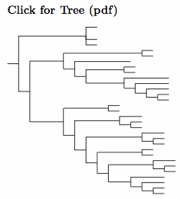
So what kind of pigeon or dove is it? Well, Bruxaux (2018) analyzed the data several ways, and there was no consensus. All had it on a very old branch of the Columbidae tree. It could even be sister to all the rest of the Columbidae, or related to the Phabini, echoing Olson and Wiley. In the end I put it in its own subfamily Starnoenadinae (Bonaparte, 1855) and took out of the main linear order as in this tree. That didn't last. The first paper from 2025 that I read was Oswald et al. (2025). They were able to show that Starnoenadinae both deserves subfamily status and is sister to the subfamily Columbinae.
Columbidae Phylogeny
 |
| Click for genus-level Columbidae tree |
|---|
The new arrangement of the Columbidae starts with the higher level studies of Prum et al. (2015) and Stiller et al. (2024). They found that the clades containing (1) Columbina, (2) Leptotila, and (3) Columba and Patagioenas are sisters. Further, that clade is sister a group of clades containing (4) Treron, (5) Alopecoenas (meaning Pampusana), (6) Caloenas, and (7) Ptilinopus.
The above represent 7 of the 8 clades that form Columbidae, which we mostly rank as tribes. Using the same numbering as above, the eight tribes are (1) Claravini = Claravinae, (2) Zenaidini, (3) Columbini, (8) Chalcophabini, (4) Treronini, (5) Phabini, (6) Raphini, and (7) Ptilinopini. Don't forget that there's also Starnoenas, which is in its own subfamily (and implicitly, tribe). Chalcophabini and Treronini often cluster together, but has low support in Oliver et al. (2023).
The Columbidae genus tree shows how these fit together. The family Claravinae consists of a single tribe, Claravini. It's sister group, Columbinae, contains both Zenaidini and Columbini. These two subfamilies together are sister to a second pair of subfamilies, Treroninae and Raphinae. The former pairs Chalcopahbini and Treronini. The later is the small tribe Raphini together with the large group Ptilinopini, containing the Imperial Pigeons and Fruit Doves.
At the species leve, we mainly follow Oliver et al.'s (2023) BEAST tree (Figure S-2). This causes some divergence from the IOC 14.1 treatment. Nonetheless, I have adopted a number of splits and some name changes that align the species list with IOC, even though the order I list them in is different.
Except for the above change, the Columbidae phylogentic trees mostly follow the paper by Oliver et al. (2023) (supplanting Pereira et al., 2007). It provides a pretty comprehensive DNA-based phylogenetic tree. The arrangement above tribal level has been a bit unstable as various papers have come out. Basing it on Prum et al. (2015) and Stiller et al. (2024) may fix this.
Although the dodos and Rodriguez Solitaire (genera Raphus and Pezophaps) were traditionally considered a separate family in the Columbiformes, the DNA says otherwise. Shapiro et al. (2002) and Pereira et al. (2007) found that these two genera are buried deeply within the Columbidae, in the Raphinae. Although the Rodriguez Solitaire is a dove, the Reunion Solitaire seems to have actually been an ibis! See Mourer-Chauviré et al. (1995).
What is clear is that the DNA reveals three major clades. The basal clade includes a subclade (Zenaidini) consisting of the New World genera Geotrygon, Leptotila, Zenaida, together with a subclade (Columbini) containing the New World pigeons (including the Passenger Pigeon), as well as typical pigeons, cuckoo-doves, and turtle-doves. It is sister to the clade of New World Ground-Doves (Claravinae). The remining major clade contains all the remaining doves. I rank these three major clades as subfamilies: Columbinae, Claravinae, and Raphinae.
The name Peristerinae is sometimes used for Claravinae. However, this is incorrect as Peristerinae is based on the genus Peristera (Swainson 1827), which is a junior homonym of the mollusc genus Peristera (Rafinesque 1815). Thus Peristerinae is not available. The genus Peristera (Swainson 1827) was replaced by Claravis (Oberholser 1899). Todd (not Richmond) established the subfamily Claravinae in 1913, which he misspelled as Claraviinae (Dickinson and Raty, 2015).
The arrangement of Claravinae is based on Sweet and Johnson (2015). As a result, the Purple-winged Ground-Dove, Claravis geoffroyi and Maroon-chested Ground-Dove, Claravis mondetoura have been moved to Metriopelia.
The name Raphidae has often been used for a family containing dodos and solitaires. That is true here also, but the dodos and solitaires are nested well within our subfamily Raphinae, and even deeper in the family Columbidae.
The subfamily Columbinae was earlier studied in more detail by Johnson and Clayton (2000), Johnson et al. (2001), Gonzalez et al. (2009a), and Johnson and Weckstein (2011). Zenaidini and the species in Streptopelia and Columba, but not Patagioenas, have been rearranged accordingly. Although Johnson et al. (2001) argued that Nesoenas should be merged into Streptopelia, Cheke (2005) makes the case for instead moving the Malagasy Turtle-Dove to Nesoenas and distinguishing the Laughing and Spotted Doves in a separate genus. The results of Gonalez et al. (2009a) support this move, as do those of Oliver et al. (2023).
In the case of Nesoenas, both Nesoenas and Homopelia (type picturatus) have equal priority, being both named in the same work of Salvadori 1893. Cheke acted as first reviser, choosing Nesoenas. The Laughing Dove is the type of Stigmatopelia (Sundevall 1873) while the Spotted Dove is the type of Spilopelia (also Sundevall 1873). Cheke attempts to designate Stigmatopelia as the genus, but Schodde and Mason had previously (1997) chosen Spilopelia, so Spilopelia they become.
The work by Johnson and Weckstein (2011) showed that Geotrygon as usually constituted is paraphyletic with its members belonging to 3 separate clades. The Olive-backed Quail-Dove is sister to Leptotila. Banks et al. (2013) establish the genus Leptotrygon for it. The remaining quail-doves fall into at least two groups. Although Johnson and Weckstein did not include the type of Geotrygon (versicolor), a further analysis by Banks et al. (2013) included it and chrysia. The other “Geotrygon” form a clade sister to Zenaida. Banks et al. (2013) have now established the name Zentrygon for it (type costaricensis).
Jønsson et al. (2011a) and Moyle et al. (2013) studied the Alopecoenas (Pampusana) ground-doves and Gallicolumba bleeding-hearts. Jønsson et al. found that Gallicolumba was paraphyletic, and recommended splitting it into Gallicolumba (bleeding-hearts) and Alopecoenas (Australasian ground-doves). Their phylogenetic trees seemed to indicate there was still paraphyly even with the restricted Gallicolumba. The further analysis by Moyle et al. revealed issues with pseudogenes that were causing some confusion. Their results support placing the Crested Pigeon in the genus Ocyphaps. Finally, the three extinct Alopecoenas are most likely closely related to A. sanctaecrucis and A. stairi, and their placement reflects this.
2024 Changes
Zenaidini Changes
The Purple Quail-Dove Geotrygon purpurata, has been split from Sapphire Quail-Dove, Geotrygon saphirina based on SACC proposal #566.
Columbini Changes
I've moved the Lemon Dove and the three Bronze-naped Pigeons from Columba to Aplopelia, Bonaparte 1855. This genus has traditionally been used for the Lemon Dove, which is it's type. The comprehensive genetic analysis of Oliver et al. (2023) sampled two of the Bronze-naped Pigeons (iriditorques and malherbii). Both grouped with the Lemon Dove rather than with the rest of Columba. (3.50)
The English names of White-faced Dove, Turacoena manadensis, and Black Dove, Turacoena modesta, have been changed to White-faced Cuckoo-Dove and Black Cuckoo-Dove to match recent IOC changes. Further,
- Based on Ng and Rheindt (2016), Sula Cuckoo-Dove, Turacoena sulaensis, has been split from White-faced Cuckoo-Dove, Turacoena manadensis.
The following splits in Macropygia are based on Ng et al. (2016).
- Slender-billed Cuckoo-Dove, Macropygia amboinensis, has been split into Sultan's Cuckoo-Dove, Macropygia doreya, and Amboyna Cuckoo-Dove, Macropygia amboinensis.
- Bar-necked Cuckoo-Dove, Macropygia magna, has been split into Flores Sea Cuckoo-Dove, Macropygia macassariensis, Timor Cuckoo-Dove, Macropygia magna, and Tanimbar Cuckoo-Dove, Macropygia timorlaoensis.
- Enggano Cuckoo-Dove, Macropygia cinnamomea, and Barusan Cuckoo Dove, Macropygia modiglianii, have been split from Ruddy Cuckoo-Dove, Macropygia emiliana.
- The subspecies borneensis has been moved from Ruddy Cuckoo-Dove, Macropygia emiliana, to Philippine Cuckoo-Dove, Macropygia tenuirostris.
Streptopelia Collared Doves: Both subspecies of Island Collared-Dove, Streptopelia bitorquata, are elevated to species rank. They become Philippine Collared-Dove, Streptopelia dusumieri, and and Sunda Collared-Dove, Streptopelia bitorquata. See Eaton et al. (2016) and Allen (2020). (3.50)
The monotypic Burmese Collared-Dove, Streptopelia xanthocycla, is split from the now monotonic Eurasian Collared-Dove, Streptopelia decaocto. Burmese Collared-Dove can be distinguished by its yellow eye ring, darker overall, and different song. It seems amazing that the very widespread Euraisan Collared-Dove has only one subspecies, but then I recall that even the range expansion in Europe is recent, and in North America even more recent. (3.50)
Treronini Changes
Treron Green Pigeons: The Whistling Green-Pigeon, Treron formosae, is split into Taiwan Green-Pigeon, Treron formosae, which includes filipinus and Ryukyu Green-Pigeon, Treron permagnus, including medioximus. See Brazil (2009) and Allen (2020). (3.50)
Phabini Changes
The Norfolk Ground-Dove, formerly Pampusana norfolciensis, becomes Pampusana norfolkensis. The old name had been supressed by the ICZN. The new name is due to Forshaw (2015).
Raphini Changes
The order of genera in Raphini follows Oliver et al. (2023), which is slightly different from Bruxaux et al. (2018). Microgoura has been rather uncertinly placed using Bruxaux (2018), Figs. 20 and 22 (but not Fig. 21, which is rather different).
Sclater's Crowned-Pigeon, Goura sclaterii has been split from Southern Crowned-Pigeon, Goura scheepmakeri, now called Scheepmaker's Crowned-Pigeon. See del Hoyo and Collar (2014) and Bruxaux et al. (2018) on the split.
Ptilinopini Changes
Gibb and Penny (2010) investigated the fruit-doves and close relatives. They confirmed Shapiro et al.'s (2002) result that Alectroenas and Drepanoptila are embedded in fruit-dove genus Ptilinopus. Cibois et al. (2014) concured in their more complete analysis of the enlarged Ptilinopus. Moreover, they were able to include most Ptilinopus species. The current arrangement of Ptilinopus is based on their results.
They suggested a six genus treatment that retained Alectroenas and Drepanoptila, and placed parts of Ptilinopus successively in Megaloprepia, Ramphiculus, and Chrysoena. However, it was already clear from the analyses in their paper that Ptilinopus was still not monophyletic! At the time, I just lumped them all into Ptilinopus, although it was not really a good solution.
The more recent study by Oliver et al. (2023) gives a tree where only a single Ptilinopus species is out of place, the Black-naped Fruit-Dove. There seems to be a genus for it Spilotreron, Salvadori, 1882. There's just one problem. The type is melanocephalus, Forster, 1781. The 4th ed. of H&M lists 10 of these in the index, but none is a dove. HBW vol. 4 only says that melanospila has been erroneously listed as melanocephalus. I've see them equated in older sources, and on that basis I take melanospilus as the type of Spilotreron. I don't know why melanocephalus, which would have almost a century of priority, has been abandoned. The most recent use I've found was in the 1950's. (3.50)
In summary, I've carved the following 6 genera out of Ptilinopus:
- Megaloprepia, Reichenbach 1852, type magnifica
- Ramphiculus, Bonaparte 1854, type occipitalis
- Spilotreron, Salvadori 1882, type melanocephalus
- Chrysoena, Bonaparte 1854, type luteovirens
- Drepanoptila, Bonaparte 1855, type holosericea
- Alectroenas, GR Gray 1840, type nitidissima
Ducula Imperial Pigeons: The monotypic Malabar Imperial Pigeon, Ducula cuprea is split from Mountain Imperial-Pigeon, Ducula badia. See Niranjana & Praveen (2021). (3.50)
The monotypic Enggano Imperial Pigeon, Ducula oenothorax is split from Green Imperial-Pigeon, Ducula aenea, based on plumage. See Eaton et al. (2021), del Hoyo & Collar (2014). (3.50)
The monotypic Geelvink Imperial Pigeon, Ducula geelvinkiana is split from Spice Imperial-Pigeon, Ducula myristicivora, based on voice and plumage. See Beehler & Pratt (2016), Gregory (2017). (3.50)
Ptilinopus Fruit Doves: The English name of the Scarlet-capped Fruit-Dove, Ptilinopus insularis, has been changed to Henderson Fruit-Dove. (3.50)
Based on Rheindt et al. (2011a), the Maroon-chinned Fruit-Dove, Ptilinopus subgularis is split into 3 species:
- Oberholser's Fruit-Dove, Ptilinopus epius,
- Banggai Fruit-Dove, Ptilinopus subgularis, and
- Sula Fruit-Dove, Ptilinopus mangoliensis.
The Black-banded Fruit-Dove, Ptilinopus alligator, has been split from Banded Fruit-Dove, Ptilinopus cinctus. Given present knowledge, it's fairly arbitrary whether to split or lump these allopatric forms. However, one is in Australia, the other in the Lesser Sundas, and the current tendency is for such forms to be split.
The monotypic Geelvink Fruit Dove, Ptilinopus speciosus is split from Yellow-bibbed Fruit-Dove, Ptilinopus solomonensis, which includes 8 other subspecies. See Gregory (2017). (3.50)
The monotypic Purple-capped Fruit Dove, Ptilinopus ponapensis and the monotypic Kosrae Fruit Dove, Ptilinopus hernsheimi are split from the Crimson-crowned Fruit-Dove, Ptilinopus porphyraceus, which still includes fasciatus. See Cibois et al. (2014) and Hayes et al. (2016). (3.50)
The monotypic Raiatea Fruit Dove, Ptilinopus chrysogaster, is split from Gray-green Fruit-Dove, Ptilinopus purpuratus, which includes frater. See Cibois et al. 2014. (3.50)
The English name of Scarlet-capped Fruit-Dove, Ptilinopus insularis), which occurs only near Henderson Island, is now Henderson Fruit-Dove (3.50).
The citations for family-group names are now based on Young et al. (2024a, 2024b).
List of Columbidae: Doves, Pigeons Leach, 1819
50 genera, 352 species HBW-4
Claravinae: American Ground-Doves Todd, 1913
- Blue Ground-Dove, Claravis pretiosa
- Long-tailed Ground-Dove, Uropelia campestris
- Maroon-chested Ground-Dove, Paraclaravis mondetoura
- Purple-winged Ground-Dove, Paraclaravis geoffroyi
- Golden-spotted Ground-Dove, Metriopelia aymara
Click for Claravinae tree - Black-winged Ground-Dove, Metriopelia melanoptera
- Bare-faced Ground-Dove, Metriopelia ceciliae
- Bare-eyed Ground-Dove / Moreno's Ground-Dove, Metriopelia morenoi
- Blue-eyed Ground-Dove, Columbina cyanopis
- Picui Ground-Dove, Columbina picui
- Croaking Ground-Dove, Columbina cruziana
- Inca Dove, Columbina inca
- Scaled Dove, Columbina squammata
- Common Ground-Dove, Columbina passerina
- Ecuadorian Ground-Dove, Columbina buckleyi
- Ruddy Ground-Dove, Columbina talpacoti
- Plain-breasted Ground-Dove, Columbina minuta
Starnoenadinae: Blue-headed Quail-Dove Bonaparte, 1855
- Blue-headed Quail-Dove, Starnoenas cyanocephala
Columbinae Leach, 1819
Zenaidini: New World Doves and Quail-Doves Bonaparte, 1853
- Purple Quail-Dove, Osculatia purpurata
- Sapphire Quail-Dove, Osculatia saphirina
- Key West Quail-Dove, Geotrygon chrysia
- Bridled Quail-Dove, Geotrygon mystacea
- Violaceous Quail-Dove, Geotrygon violacea
- Ruddy Quail-Dove, Geotrygon montana
- Gray-fronted Quail-Dove, Geotrygon caniceps
- Crested Quail-Dove, Geotrygon versicolor
- White-fronted Quail-Dove, Geotrygon leucometopia
Click for Zenaidini tree - Olive-backed Quail-Dove, Leptotrygon veraguensis
- Caribbean Dove, Leptotila jamaicensis
- White-tipped Dove, Leptotila verreauxi
- Gray-fronted Dove, Leptotila rufaxilla
- Large-tailed Dove / Yungas Dove, Leptotila megalura
- Grenada Dove, Leptotila wellsi
- Gray-headed Dove, Leptotila plumbeiceps
- Brown-backed Dove / Azuero Dove, Leptotila battyi
- Pallid Dove, Leptotila pallida
- Gray-chested Dove, Leptotila cassinii
- Tolima Dove, Leptotila conoveri
- Ochre-bellied Dove, Leptotila ochraceiventris
- White-winged Dove, Zenaida asiatica
- West Peruvian Dove, Zenaida meloda
- Mourning Dove, Zenaida macroura
- Socorro Dove, Zenaida graysoni
- Zenaida Dove, Zenaida aurita
- Eared Dove, Zenaida auriculata
- Galapagos Dove, Zenaida galapagoensis
- Buff-fronted Quail-Dove, Zentrygon costaricensis
- Tuxtla Quail-Dove, Zentrygon carrikeri
- Purplish-backed Quail-Dove, Zentrygon lawrencii
- White-faced Quail-Dove, Zentrygon albifacies
- White-throated Quail-Dove, Zentrygon frenata
- Lined Quail-Dove, Zentrygon linearis
- Chiriqui Quail-Dove, Zentrygon chiriquensis
- Russet-crowned Quail-Dove, Zentrygon goldmani
Columbini Leach, 1819
- †Passenger Pigeon, Ectopistes migratorius
- Band-tailed Pigeon, Patagioenas fasciata
- Ring-tailed Pigeon, Patagioenas caribaea
- Chilean Pigeon, Patagioenas araucana
- Scaled Pigeon, Patagioenas speciosa
- White-crowned Pigeon, Patagioenas leucocephala
- Scaly-naped Pigeon, Patagioenas squamosa
- Ruddy Pigeon, Patagioenas subvinacea
- Short-billed Pigeon, Patagioenas nigrirostris
- Dusky Pigeon, Patagioenas goodsoni
- Plumbeous Pigeon, Patagioenas plumbea
Click for Columbini tree,
Part I - Plain Pigeon, Patagioenas inornata
- Red-billed Pigeon, Patagioenas flavirostris
- Peruvian Pigeon / Maranon Pigeon, Patagioenas oenops
- Spot-winged Pigeon, Patagioenas maculosa
- Pale-vented Pigeon, Patagioenas cayennensis
- Bare-eyed Pigeon, Patagioenas corensis
- Picazuro Pigeon, Patagioenas picazuro
- Great Cuckoo-Dove, Reinwardtoena reinwardti
- Pied Cuckoo-Dove, Reinwardtoena browni
- Crested Cuckoo-Dove, Reinwardtoena crassirostris
- Black Cuckoo-Dove, Turacoena modesta
- White-faced Cuckoo-Dove, Turacoena manadensis
- Sula Cuckoo-Dove, Turacoena sulaensis
- Bar-tailed Cuckoo-Dove, Macropygia nigrirostris
- Barred Cuckoo-Dove, Macropygia unchall
- MacKinlay's Cuckoo-Dove, Macropygia mackinlayi
- Little Cuckoo-Dove, Macropygia ruficeps
- Andaman Cuckoo-Dove, Macropygia rufipennis
- Barusan Cuckoo-Dove, Macropygia modiglianii
- Enggano Cuckoo-Dove, Macropygia cinnamomea
- Amboyna Cuckoo-Dove, Macropygia amboinensis
- Sultan's Cuckoo-Dove, Macropygia doreya
- Ruddy Cuckoo-Dove, Macropygia emiliana
- Flores Sea Cuckoo-Dove, Macropygia macassariensis
- Timor Cuckoo-Dove, Macropygia magna
- Tanimbar Cuckoo-Dove, Macropygia timorlaoensis
- Philippine Cuckoo-Dove, Macropygia tenuirostris
- Brown Cuckoo-Dove, Macropygia phasianella
- Laughing Dove, Spilopelia senegalensis
- Spotted Dove, Spilopelia chinensis
- Malagasy Turtle-Dove, Nesoenas picturata
- Pink Pigeon, Nesoenas mayeri
- †Rodrigues Pigeon, Nesoenas rodericana
- Philippine Collared-Dove, Streptopelia dusumieri
- Sunda Collared-Dove, Streptopelia bitorquata
- Red Collared-Dove, Streptopelia tranquebarica
- Oriental Turtle-Dove, Streptopelia orientalis
- European Turtle-Dove, Streptopelia turtur
- Adamawa Turtle-Dove, Streptopelia hypopyrrha
- Dusky Turtle-Dove, Streptopelia lugens
- Red-eyed Dove, Streptopelia semitorquata
- Vinaceous Dove, Streptopelia vinacea
- Ring-necked Dove, Streptopelia capicola
- Mourning Collared-Dove, Streptopelia decipiens
- Eurasian Collared-Dove, Streptopelia decaocto
- Burmese Collared-Dove, Streptopelia xanthocycla
- African Collared-Dove, Streptopelia roseogrisea
- White-winged Collared-Dove, Streptopelia reichenowi
- Lemon Dove, Aplopelia larvata
- Western Bronze-naped Pigeon, Aplopelia iriditorques
- Island Bronze-naped Pigeon, Aplopelia malherbii
- Eastern Bronze-naped Pigeon, Aplopelia delegorguei
- †Bonin Woodpigeon, Columba versicolor
- †Ryukyu Woodpigeon, Columba jouyi
- Black Woodpigeon, Columba janthina
- Metallic Pigeon, Columba vitiensis
- Yellow-legged Pigeon, Columba pallidiceps
- White-headed Pigeon, Columba leucomela
- Ashy Woodpigeon, Columba pulchricollis
Click for Columbini tree,
part II - Nilgiri Woodpigeon, Columba elphinstonii
- Andaman Woodpigeon, Columba palumboides
- Sri Lanka Woodpigeon, Columba torringtoniae
- Pale-capped Pigeon, Columba punicea
- Silvery Pigeon, Columba argentina
- Laurel Pigeon, Columba junoniae
- Speckled Woodpigeon, Columba hodgsonii
- White-naped Pigeon, Columba albinucha
- Sao Tome Olive-Pigeon, Columba thomensis
- Cameroon Olive-Pigeon, Columba sjostedti
- African Olive-Pigeon, Columba arquatrix
- Comoros Olive-Pigeon, Columba pollenii
- Common Woodpigeon, Columba palumbus
- Trocaz Pigeon, Columba trocaz
- Bolle's Pigeon, Columba bollii
- Afep Pigeon, Columba unicincta
- Speckled Pigeon, Columba guinea
- White-collared Pigeon, Columba albitorques
- Snow Pigeon, Columba leuconota
- Rock Pigeon / Rock Dove, Columba livia
- Hill Pigeon, Columba rupestris
- Stock Dove, Columba oenas
- Yellow-eyed Pigeon, Columba eversmanni
- Somali Pigeon, Columba oliviae
Treroninae: Emerald and Wood Doves, Green-Pigeons G.R. Gray, 1840 (1836)
Chalcophabini: Emerald and Wood Doves Bonaparte, 1855
- Stephan's Emerald-Dove, Chalcophaps stephani
- Common Emerald-Dove, Chalcophaps indica
- Pacific Emerald-Dove, Chalcophaps longirostris
- Namaqua Dove, Oena capensis
- Tambourine Dove, Turtur tympanistria
Click for Treroninae tree - Blue-headed Wood-Dove, Turtur brehmeri
- Blue-spotted Wood-Dove, Turtur afer
- Black-billed Wood-Dove, Turtur abyssinicus
- Emerald-spotted Wood-Dove, Turtur chalcospilos
Treronini: Green-Pigeons G.R. Gray, 1840 (1836)
- Cinnamon-headed Green-Pigeon, Treron fulvicollis
- Ashy-headed Green-Pigeon, Treron phayrei
- Philippine Green-Pigeon, Treron axillaris
- Buru Green-Pigeon, Treron aromaticus
- Thick-billed Green-Pigeon, Treron curvirostra
- Gray-cheeked Green-Pigeon, Treron griseicauda
- Sumba Green-Pigeon, Treron teysmannii
- Flores Green-Pigeon, Treron floris
- Timor Green-Pigeon, Treron psittaceus
- Gray-fronted Green-Pigeon, Treron affinis
- Sri Lanka Green-Pigeon, Treron pompadora
- Andaman Green-Pigeon, Treron chloropterus
- Pin-tailed Green-Pigeon, Treron apicauda
- Sumatran Green-Pigeon, Treron oxyurus
- Yellow-vented Green-Pigeon, Treron seimundi
- White-bellied Green-Pigeon, Treron sieboldii
- Wedge-tailed Green-Pigeon, Treron sphenurus
- Taiwan Green-Pigeon, Treron formosae
- Ryukyu Green Pigeon, Treron permagnus
- Orange-breasted Green-Pigeon, Treron bicinctus
- Pink-necked Green-Pigeon, Treron vernans
- Little Green-Pigeon, Treron olax
- Yellow-footed Green-Pigeon, Treron phoenicopterus
- Large Green-Pigeon, Treron capellei
- Comoros Green-Pigeon, Treron griveaudi
- Bruce's Green-Pigeon, Treron waalia
- Madagascan Green-Pigeon, Treron australis
- African Green-Pigeon, Treron calvus
- Sao Tome Green-Pigeon, Treron sanctithomae
- Pemba Green-Pigeon, Treron pembaensis
Raphinae: Old World Doves and Pigeons Oudemans 1917 (1828)
Phabini: Australasian Pigeons and Doves Bonaparte, 1853
- Sulawesi Ground-Dove, Diopezus tristigmatus
- Cinnamon Ground-Dove, Gallicolumba rufigula
- Mindoro Bleeding-heart, Gallicolumba platenae
- Sulu Bleeding-heart, Gallicolumba menagei
- Mindanao Bleeding-heart, Gallicolumba crinigera
- Luzon Bleeding-heart, Gallicolumba luzonica
- Negros Bleeding-heart, Gallicolumba keayi
- New Guinea Bronzewing, Henicophaps albifrons
- New Britain Bronzewing, Henicophaps foersteri
- Wetar Ground-Dove, Pampusana hoedtii
- White-breasted Ground-Dove, Pampusana jobiensis
- Marquesan Ground-Dove, Pampusana rubescens
- White-fronted Ground-Dove, Pampusana kubaryi
Click for Phabini tree - White-throated Ground-Dove, Pampusana xanthonura
- Polynesian Ground-Dove, Pampusana erythroptera
- Palau Ground-Dove, Pampusana canifrons
- Bronze Ground-Dove, Pampusana beccarii
- Tongan Ground-Dove, Pampusana stairi
- Santa Cruz Ground-Dove, Pampusana sanctaecrucis
- †Thick-billed Ground-Dove, Pampusana salamonis
- †Tanna Ground-Dove, Pampusana ferruginea
- †Norfolk Ground-Dove, Pampusana norfolkensis
- Wonga Pigeon, Leucosarcia melanoleuca
- Crested Pigeon, Ocyphaps lophotes
- White-quilled Rock-Pigeon, Petrophassa albipennis
- Chestnut-quilled Rock-Pigeon, Petrophassa rufipennis
- Bar-shouldered Dove, Geopelia humeralis
- Diamond Dove, Geopelia cuneata
- Zebra Dove, Geopelia striata
- Barred Dove, Geopelia maugeus
- Peaceful Dove, Geopelia placida
- Flock Bronzewing, Phaps histrionica
- Common Bronzewing, Phaps chalcoptera
- Brush Bronzewing, Phaps elegans
- Spinifex Pigeon, Geophaps plumifera
- Partridge Pigeon, Geophaps smithii
- Squatter Pigeon, Geophaps scripta
Raphini: Terrestral Pigeons Oudemans 1917 (1828)
- †Choiseul Pigeon, Microgoura meeki
Click for Raphini tree - Thick-billed Ground-Pigeon, Trugon terrestris
- Pheasant Pigeon, Otidiphaps nobilis
- †Dodo, Raphus cucullatus
- †Rodrigues Solitaire, Pezophaps solitaria
- Nicobar Pigeon, Caloenas nicobarica
- †Spotted Green Pigeon, Caloenas maculata
- Tooth-billed Pigeon, Didunculus strigirostris
- Western Crowned-Pigeon, Goura cristata
- Sclater's Crowned-Pigeon, Goura sclaterii
- Scheepmaker's Crowned-Pigeon, Goura scheepmakeri
- Victoria Crowned-Pigeon, Goura victoria
Ptilinopini: Fruit-Doves and Imperial-Pigeons Selby, 1835
- White-eared Brown-Dove, Phapitreron leucotis
- Amethyst Brown-Dove, Phapitreron amethystinus
- Tawitawi Brown-Dove, Phapitreron cinereiceps
- Mindanao Brown-Dove, Phapitreron brunneiceps
- New Zealand Pigeon, Hemiphaga novaeseelandiae
- Chatham Pigeon, Hemiphaga chathamensis
- Topknot Pigeon, Lopholaimus antarcticus
Click for Ptilinopini tree,
part I - Papuan Mountain-Pigeon, Gymnophaps albertisii
- Buru Mountain-Pigeon, Gymnophaps mada
- Seram Mountain-Pigeon, Gymnophaps stalkeri
- Pale Mountain-Pigeon, Gymnophaps solomonensis
- Sombre Pigeon, Cryptophaps poecilorrhoa
- Zoe's Imperial-Pigeon, Ducula zoeae
- Malabar Imperial Pigeon, Ducula cuprea
- Mountain Imperial-Pigeon, Ducula badia
- Dark-backed Imperial-Pigeon, Ducula lacernulata
- Timor Imperial-Pigeon, Ducula cineracea
- Spotted Imperial-Pigeon, Ducula carola
- Mindoro Imperial-Pigeon, Ducula mindorensis
- Gray-headed Imperial-Pigeon, Ducula radiata
- Pink-bellied Imperial-Pigeon, Ducula poliocephala
- White-bellied Imperial-Pigeon, Ducula forsteni
- Cinnamon-bellied Imperial-Pigeon, Ducula basilica
- Finsch's Imperial-Pigeon, Ducula finschii
- Rufescent Imperial-Pigeon, Ducula chalconota
- Purple-tailed Imperial-Pigeon, Ducula rufigaster
- Green Imperial-Pigeon, Ducula aenea
- Nicobar Imperial-Pigeon, Ducula nicobarica
- Enggano Imperial Pigeon, Ducula oenothorax
- Elegant Imperial-Pigeon, Ducula concinna
- Spectacled Imperial-Pigeon, Ducula perspicillata
- Seram Imperial-Pigeon, Ducula neglecta
- Gray Imperial-Pigeon, Ducula pickeringii
- Island Imperial-Pigeon, Ducula pistrinaria
- Pink-headed Imperial-Pigeon, Ducula rosacea
- Christmas Imperial-Pigeon, Ducula whartoni
- Red-knobbed Imperial-Pigeon, Ducula rubricera
- Spice Imperial-Pigeon, Ducula myristicivora
- Geelvink Imperial Pigeon, Ducula geelvinkiana
- Micronesian Imperial-Pigeon, Ducula oceanica
- Marquesan Imperial-Pigeon, Ducula galeata
- Pacific Imperial-Pigeon, Ducula pacifica
- Polynesian Imperial-Pigeon, Ducula aurorae
- Goliath Imperial-Pigeon, Ducula goliath
- Barking Imperial-Pigeon, Ducula latrans
- Collared Imperial-Pigeon, Ducula mullerii
- Black Imperial-Pigeon, Ducula melanochroa
- Vanuatu Imperial-Pigeon, Ducula bakeri
- Pinon's Imperial-Pigeon, Ducula pinon
- Chestnut-bellied Imperial-Pigeon, Ducula brenchleyi
- Pied Imperial-Pigeon, Ducula bicolor
- Silver-tipped Imperial-Pigeon, Ducula luctuosa
- Torresian Imperial-Pigeon, Ducula spilorrhoa
- Yellowish Imperial-Pigeon, Ducula subflavescens
Click for Ptilinopini tree,
part II - Scarlet-breasted Fruit-Dove, Megaloprepia bernsteinii
- Wompoo Fruit-Dove, Megaloprepia magnifica
- Flame-breasted Fruit-Dove, Ramphiculus marchei
- Cream-breasted Fruit-Dove, Ramphiculus merrilli
- Yellow-breasted Fruit-Dove, Ramphiculus occipitalis
- Red-eared Fruit-Dove, Ramphiculus fischeri
- Jambu Fruit-Dove, Ramphiculus jambu
- Oberholser's Fruit-Dove, Ramphiculus epius
- Banggai Fruit-Dove, Ramphiculus subgularis
- Sula Fruit-Dove, Ramphiculus mangoliensis
- Black-chinned Fruit-Dove, Ramphiculus leclancheri
- Orange Fruit-Dove, Chrysoena victor
- Golden Fruit-Dove, Chrysoena luteovirens
- Whistling Fruit-Dove, Chrysoena layardi
- Negros Fruit-Dove, ``Spilotreron'' arcanus
- Black-naped Fruit-Dove, Spilotreron melanospilus
- Madagascan Blue-Pigeon, Alectroenas madagascariensis
- †Mauritius Blue-Pigeon, Alectroenas nitidissima
- Comoros Blue-Pigeon, Alectroenas sganzini
- Seychelles Blue-Pigeon, Alectroenas pulcherrima
- Cloven-feathered Dove, Drepanoptila holosericea
- Dwarf Fruit-Dove, Drepanoptila naina
- Pink-headed Fruit-Dove, Ptilinopus porphyreus
- Banded Fruit-Dove, Ptilinopus cinctus
- Red-naped Fruit-Dove, Ptilinopus dohertyi
- Black-banded Fruit-Dove, Ptilinopus alligator
- Superb Fruit-Dove, Ptilinopus superbus
- White-bibbed Fruit-Dove, Ptilinopus rivoli
- Geelvink Fruit Dove, Ptilinopus speciosus
- Yellow-bibbed Fruit-Dove, Ptilinopus solomonensis
- Tanna Fruit-Dove, Ptilinopus tannensis
- Orange-bellied Fruit-Dove, Ptilinopus iozonus
- Claret-breasted Fruit-Dove, Ptilinopus viridis
- White-headed Fruit-Dove, Ptilinopus eugeniae
- Knob-billed Fruit-Dove, Ptilinopus insolitus
- Gray-headed Fruit-Dove, Ptilinopus hyogastrus
- Carunculated Fruit-Dove, Ptilinopus granulifrons
- Pink-spotted Fruit-Dove, Ptilinopus perlatus
- Orange-fronted Fruit-Dove, Ptilinopus aurantiifrons
- Wallace's Fruit-Dove, Ptilinopus wallacii
- Ornate Fruit-Dove, Ptilinopus ornatus
- Beautiful Fruit-Dove, Ptilinopus pulchellus
- Blue-capped Fruit-Dove, Ptilinopus monacha
- Coroneted Fruit-Dove, Ptilinopus coronulatus
- Rose-crowned Fruit-Dove, Ptilinopus regina
- White-capped Fruit-Dove, Ptilinopus dupetithouarsii
- †Red-moustached Fruit-Dove, Ptilinopus mercierii
- Crimson-crowned Fruit-Dove, Ptilinopus porphyraceus
- Red-bellied Fruit-Dove, Ptilinopus greyi
- Purple-capped Fruit Dove, Ptilinopus ponapensis
- Kosrae Fruit Dove, Ptilinopus hernsheimi
- Palau Fruit-Dove, Ptilinopus pelewensis
- Mariana Fruit-Dove, Ptilinopus roseicapilla
- Silver-capped Fruit-Dove, Ptilinopus richardsii
- Many-colored Fruit-Dove, Ptilinopus perousii
- Gray-green Fruit-Dove, Ptilinopus purpuratus
- Lilac-crowned Fruit-Dove, Ptilinopus rarotongensis
- Raiatea Fruit Dove, Ptilinopus chrysogaster
- Rapa Fruit-Dove, Ptilinopus huttoni
- Henderson Fruit-Dove, Ptilinopus insularis
- Makatea Fruit-Dove, Ptilinopus chalcurus
- Atoll Fruit-Dove, Ptilinopus coralensis