New World Suboscines II: Furnariida Ames, 1971
The latest changes from the SACC have been used in restructuring the Furnariida, although we follow a different ordering based on Chesser (2004; see also Fjeldså et al., 2003; Irestedt et al., 2001, 2002; Moyle et al., 2009; Rice, 2005). This order is also supported by Harvey et al. (2020). We separate the Furnariida into 7 families, all of which are older than 30 millon years, according to Harvey et al. (2020). The dates given by Oliveros et al. (2019) are a bit younger, but still in the Oligocene.
The recognition of three of these families is relatively recent, and required the use of genetic information. In 1900, four groups were recognized as families: Tapaculos, Gnateaters, Antbirds, and Ovenbirds (including Woodcreepers). Needless to say, the boundaries of these groups were a bit different then.
This type of arrangement continued in use until the work of Sibley, Ahlquist, and Monroe, based on DNA hybridization in the late 1980s and early 1990s. The Sibley and Monroe checklist (1993) included five of these families: Thamnophilidae (Antbirds), Furnariidae (Ovenbirds, Woodcreepers), Formicariidae (Antthrushes, Antpittas, Conopophagidae (Gnateaters, minus Pittasoma), and Rhinocryptidae (Crescent-chests, Tapaculos). Since them, the antpittas and crescent-chests have been given their own families. The SACC proposal to accept the crescent-chests as a family wasn't passed until January 2007. By now, this looks pretty solid. And after the publication of Harvey et al. (2020), there is no place for any other families to hide in Furnariida.
The Myrmotheridae (antpittas) have been separated from the Formicariidae (antthrushes) because the tapaculos are more closely related to the remaining antthrushes than the antpittas are. Similar issues lead to a separation of the Melanopareiidae (crescent-chests) and the Rhinocryptidae (tapaculos). The Pittasoma antpittas have been moved to the Conopophagidae. The tree below shows the basic structure of the Furnariida.
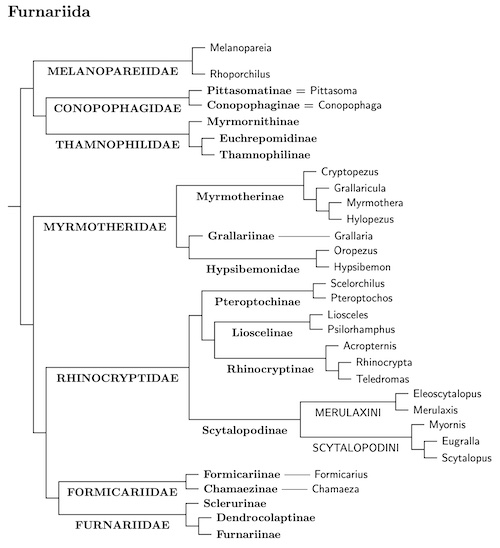
The family structure and arrangement of genera are based on Harvey et al. (2020), although I previously used a similar tree based on Ohlson et al. (2013a) for the families. As Melanopareiidae, Conopophagidae, and Formicariidae each involve only one or two genera, the arrangement there is trival (small genus first). The two large groups, Thamnophilidae and Furnariidae are much more complex, and will be treated separately in detail.
Moyle et al. (2009), suggest raising both Sclerurinae (leaftossers and miners) and Dendrocolaptinae (woodcreepers) to family rank. For fans of temporal distance, there are divisions within some of the other families that are deeper, including all three antbird subfamilies. Personally, I'm not in favor of further dividing the antpittas, tapaculos, or antthrushes, into families as there are too few taxa involved and the groups seem pretty coherent as is.
Melanopareiidae: Crescent-chests Ericson et al., 2010
2 genera, 4 species Not HBW Family
The Elegant Crescent-chest, Melanopareia elegans, and Maranon Crescent-chest, Rhoporchilus maranonica, are transferred to Rhoporchilus (Ridgway 1909, type Formicivora speciosa Salvin = Synallaxis elegans Lesson, in other words, the Elegant Crescent-chest. Although they look pretty similar, the genera Melanopareia and Rhoporchilus separated about 12.7 mya.
- Olive-crowned Crescent-chest, Melanopareia maximiliani
- Collared Crescent-chest, Melanopareia torquata
- Elegant Crescent-chest, Rhoporchilus elegans
- Maranon Crescent-chest, Rhoporchilus maranonicus
Conopophagidae: Gnateaters Sclater and Salvin, 1873
2 genera, 11 species HBW-8
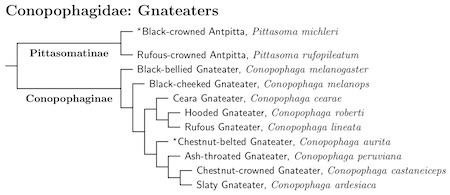
The arrangement of taxa is based on Harvey et al. (2020). They found that Pittasoma and Conopohaga split 17.7 mya. To highlight this deep division, I've separated then in two subfamilies: Pittasomatinae and Conopophagiane.
Bock (1994) attributes Pittasomatidae to Ridgway (1911). Remsen relates in SACC #235 that he searched for it, and could not find it. I used Google, which has apparently scanned all of the volumes of Ridgway's The Birds of North and Middle America. I searched for family, subfamily, and tribe for both Pittasomidae and Pittasomatidae. Nada. Bock strikes again!
In spite of this, he was not actually wrong! Rather, the problem comes from not properly citing the source. As Laurent Raty put it, “he never cited the original spelling of what he thought was an available name, and he never gave the page on which this name was used.” That's a bit of an exaggeration. Sometimes, the original was in Bock's preferred form, in which case he correctly cited the name. If not, you're on your own finding it. In this case, the original name was Pittasomae (ranked as a group) on p.17 of Ridgway (1911).
Pessoa (2007) and Batalha-Filho et al. (2014) found evidence supporting the split of Ceara Gnateater, Conopophaga cearae, from Rufous Gnateater, Conopophaga lineata. Batalha-Filho et al. noted additional genetic structure within melanops, castaneiceps, lineata (even once cearae is separated), and aurita. With further study, additional splits may be supported.
Pittasomatinae: Not really Antpittas Ridgway, 1911
- Black-crowned Antpitta, Pittasoma michleri
- Rufous-crowned Antpitta, Pittasoma rufopileatum
Conopophaginae: Gnateaters Sclater and Salvin, 1873
- Black-bellied Gnateater, Conopophaga melanogaster
- Black-cheeked Gnateater, Conopophaga melanops
- Ceara Gnateater, Conopophaga cearae
- Hooded Gnateater, Conopophaga roberti
- Rufous Gnateater, Conopophaga lineata
- Chestnut-belted Gnateater, Conopophaga aurita
- Ash-throated Gnateater, Conopophaga peruviana
- Chestnut-crowned Gnateater, Conopophaga castaneiceps
- Slaty Gnateater, Conopophaga ardesiaca
Thamnophilidae: Antbirds Swainson, 1824
Antbird Chaos, Introduction
 |
| Click for Thamnophilidae genus tree |
|---|
Due to Moyle et al. (2009), the taxonomy of the antbirds has been drastically changed. It was already clear from Brumfield et al. (2007) that changes were needed. Those two papers, with some help from Aleixo et al. (2009) and Irestedt et al. (2004b), drove this reorganization. Moyle et al. (2009) and Brumfield et al. (2007) find the same major clades (designated tribes by Moyle et al.) and many of the same subclades. This has been touched-up some using Belmonte-Lopes et al. (2012), Bravo et al. (2012a, b), Isler et al. (2013, 2014), and of course Harvey et al. (2020).
Two genera have posed particular problems: Myrmotherula and Myrmeciza. Isler et al. (2013) finished the dismemberment of Myrmeciza, and Myrmotherula is suffering a similar fate.
Antbird Chaos, Myrmotherula
We consider Myrmotherula first. It once comprised 41 species (TiF count as of 7/20/21). Those 41 species are now spread across 7 genera in 3 tribes: Microrhopiini, Formicivorini and Thamnophilini. The genera involved are Epinecrophylla, Myrmotherula, Neorhopias, Myrmopagis, Isleria, Rhopias, and a genus without a name that I'm temporarily calling "Myrmotherula". Although Myrmopagis can be construed as a single genus if using the Harvey et al. (2020) phylogeny, some of the other analyses require it be at least three genera, one of which doesn't have a name.
For Myrmotherula the process started when Isler et al. (2006) separated the stipple-throated species from the rest, creating the genus Epinecrophylla for them (Isler and Brumfield, 2006, type haematonota). This was a big step forward. The genus Epinecrophylla is fairly distant from the other Myrmotherula, over 16 million years distant. Accordingly, Myrmotherula is in the tribe Microrhopiini while the other Myrmotherula are mostly in Formicivorini, with the rest in Thamnophilini.
The remaining Myrmotherula were still not monophyletic (Hackett and Rosenberg, 1990; Irestedt et al, 2004b; Brumfield et al., 2007; Belmonte-Lopes, 2012; Bravo et al., 2014). These species fall into two broad groups, streaked and gray. The type species of Myrmotherula is in the streaked group, so they are the true Myrmotherula. However, these species alone do not form a clade. We have to add the distinctive, unstreaked, Black-and-white Antbird (previously Myrmochanes hemileucus) to complete the clade (Bravo et al., 2014).
The Black-and-white is a denizen of early successional habitats on river islands. I've only seen it once, on an island in the Rio Madeira near Novo Aripuanã. Birds of the World notes that “its preferred habitat often is totally submerged during the wet season, and therefore it must be able to fly reasonable distances over water to find suitable habitat, a behavior perhaps unique in the antbird family.” It's not exactly what one would expect to complete the genus, but there it is.
We still have 19 species left, all of which can be considered part of the gray group. But there's a problem. The gray “group” is not a clade. Many species of the gray group are closely related to Formicivora (Irestedt et al., 2004). Early analysis found them forming a paraphyletic grade rather than a clade (Bravo et al., 2014), but in Harvey et al. (2020), 12 of them form a clade, for which the name Myrmopagis is available. Since Myrmopagis is fairly homogeneous, I don't have a problem with that even though some of the species are a little distant (> 10 million years) to be in the same genus.
This clade divides naturally into three subclades, which arguably could be ranked as genera. One consists of the Gray and Leaden Antwrens (Poliolaema), the second is comprised of the White-flanked, Long-billed and Band-tailed Antwrens (Myrmopagis), the third consists of the rest of Myrmopagis and doesn't seem to have an available name.
This leaves us with 7 species of former Myrmotherula Four of them are closely related to Formicivora. We'll cover them first. These four, the three members of the Ihering's Antbird complex and the mysterious Rio de Janeiro Antwren, known only from the type specimen (included in the Harvey tree), are sister to the basal member of Formicivora. Formicivora is a rather heterogeneous genus, and its basal member, the Narrow-billed Antwren (F. iheringi) is only distantly related to the others. I have moved it and the Rio de Janeiro Antwren to the genus Neorhopias. Although the Ihering's Antbird complex (based on M. iheringi) is sister to Neorhopias, I have left it the temporary name "Myrmotheurla". There are three reasons for this. The genera Neorhopias and "Myrmotheurla" are visually distinct, there is substantial genetic distance between them (over 9 million years), and, we have a name conflict if both F. iheringi and M. iheringi appear in the same genus.
The last three former Myrmotheurla merely appear to be Myrmotheurla. In fact, they are 15 million years distant from Myrmotheurla, in the tribe Thamnophilini rather than Formicivorini. These include the Plain-throated and Rufous-bellied Antwrens, now in Isleria and the distinctive Star-throated Antwren, now called Rhopias gularis.
Antbird Chaos, Myrmeciza
The other problem genus is Myrmeciza. One big problem is that the traditional Myrmeciza pop up all over the tree. Brumfield et al. (2007) included 10 of the 22 Myrmeciza species in their study, and they ended up in 5 independent clumps. Irestedt et al. (2004b) identified another clump, and Isler et al. (2013) added a couple more. That gives us eight groups of "Myrmeciza", and Isler et al. (2013) showed us how to split them up.
- The Yapacana Antbird, discovered by Friedmann (1945), was previously considered a rather aberrant Myrmeciza . Apparently the type specimen was molting, and Zimmer (1990) tells us that this has led to some inaccurate descriptions and illustrations of the species. Zimmer (1999) questioned whether it belonged in Myrmeczia (or in any currently existing genus). I had previously placed it next to Sclateria as Ridgely and Tudor (1994), Hilty (2003), and Zimmer and Isler (2003) drew attention to their similarity. Isler et al. (2013) included it in their analysis and found it best placed in a new monotypic genus next to Myrmophylax and Ammonastes. They named the genus Aprositornis, so the Yapacana Antbird is now Aprositornis disjuncta (Isler et al., 2013).
- The next group is atrothorax and pelzelni. It and Aprositornis belong in Microrhopiini. I had previously separated these two species as Myrmophylax (Todd 1927, type atrothorax). However, Isler et al. (2013) note that the Black-throated Antbird, Myrmophylax atrothorax, and Gray-bellied Antbird are rather different. They created the new genus Ammonastes (Bravo et al., 2013) for the Gray-bellied Antbird, Ammonastes pelzelni.
- Most of the "Myrmeciza" are in Pyriglenini, and we now turn to that. I'd previously moved four species: ferrugineus, ruficauda, loricatus, and squamosus to Myrmoderus (Ridgway 1909, type loricatus). Isler et al. (2013) support that decision. Since then, they have been joined by the recently described Cordillera Azul Antbird, Myrmoderus eowilsoni, which is included in Harvey et al. (2020).
- There had previously been some question about whether the
Myrmeciza type, longipes was part of the next group or not.
Isler et al. (2013) resolved that. They are separate. They also recommended 3
genera for this rather heterogeneous group. The new genus Poliocrania
(Bravo et al., 2013) applies to the Chestnut-backed Antbird, Poliocrania
exsul, while the new genus Ampelornis (Isler et al, 2013) applies
to the Gray-headed Antbird, Ampelornis griseiceps. is the new genus
Ampelornis. The others are more similar, and all take the old name
Sipia (Hellmayr 1924, type berlepschi). They are the
Dull-mantled Antbird, S. laemosticta, Magdalena Antbird, S.
palliata, Stub-tailed Antbird, S. berlepschi, and Esmeraldas
Antbird, S. nigricauda.
NB. S. palliata, has been split from Dull-mantled Antbird, S. laemosticta. See Chaves et al. (2010) and SACC #475. - The White-bellied Antbird, Myrmeciza longipes, is the type species of Myrmeciza. Amazingly, Isler et al. (2013) found that none of the putative Myrmeciza are closely related to it. Thus the former large genus Myrmeciza is reduced to a single species.
- The Plumbeous Antbird, M. hyperythrus, is actually part of the Schistocichla group. This is a little surprising as most of the Schistocichla were formerly classified as a single species. Since hyperythrus is the type of Myrmelastes (Sclater 1858), and it is senior to Schistocichla (WEC Todd 1927), the whole group becomes Myrmelastes.
- The next group had previously been treated as Myrmeciza3 in lieu of
a proper name. Well, Isler et al. (2013) gave it two names: Hafferia
(Isler et al., type immaculata) and Inundicola (Bravo et al.,
type melanoceps).
There's a complication. As pointed out by Jobling, the name Akletos (Dunajewski 1948, type melanoceps) has priority over Inundicola. Dunajewski named the female as a separate species and genus, not realizing that the male was previously known. The SACC had it listed under “Hybrids and Dubious Taxa”. That Dunajewski named the female makes no difference as far as the Code is concerned, Akletos has priority.
I wasn't originally convinced that there was so much difference as to justify two genera. However, Akletos and Hafferia are not sister taxa, so we need both. Donegan (2012a) suggested it might make sense to go even further and combine these taxa with Gymnocichla, Percnostola, and Pyriglena. I think that would make an overly large and overly heterogeneous genus.
The members of Akletos are the White-shouldered Antbird, A. melanoceps, and Goeldi's Antbird, A. goeldii. As for Hafferia, it contains Sooty Antbird, H. fortis, Zeledon's Antbird, H. zeledoni and Blue-lored Antbird, H. immaculata. The last two are the former Immaculate Antbird, which has been split into Zeledon's and Blue-lored Antbirds. See Donegan (2012a). - Moving to Drymophilini, we find the group I'd formerly labeled Myrmeciza4. This clade now has a name, Sciaphylax (Bravo et al., 2013, type hemimelaena). It includes Zimmer's Antbird, Sciaphylax castanea and the Chestnut-tailed Antbird, Sciaphylax hemimelaena.
Notes — Thamnophilidae
Bravo et al. (2012b) found that Terenura consisted of two unrelated clades. The type species of Terenura is close to the type of the Myrmotherula antwrens, while the other clade is the basal in the Antbird family, Thamnophilidae. Bravo et al. (2012b) established the genus name Euchrepomis and subfamily Euchrepomidinae to accomodate the basal clade.
I've split one of Moyle et al.'s tribes into two parts, Pithyini and Drymophilini. This is done to highlight the fact that most of the obligate army ant followers are in Pithyini. Indeed, of the 18 species of olibgate ant followers listed in Zimmer and Isler (2003, p.497), only the Pyriglena fire-eyes are outside of Pithyini. They are also a bit different from the Pithyini ant-followers in that they are sometimes found feeding away from ant swarms. Of the Pithyini, only the two Willisornis antbirds are not obligate ant-followers. Still, they are regular ant-followers (2 of 7 such species according to Zimmer and Isler; the other 5 are in Pyriglenini). In contrast, none of the Drymophilini are either obligate or regular ant-followers. For a fuller discussion of ant-following, see Zimmer and Isler (2003, pp.495-503).
Thamnophilidae: Antbirds Swainson, 1824
68 genera, 251 species HBW-8
Notes — Myrmornithinae
|
| Click for Thamnophilidae species tree |
|---|
Wing-banded Antbird: Based on Harvey et al. (2020) and HBW Checklist, the Wing-banded Antbird, Myrmornis torquata, is split into:
- Northern Wing-banded Antbird, Myrmornis stictoptera
- Southern Wing-banded Antbird, Myrmornis torquata
Russet Antshrike: Based on SACC decisions #758 and #792.2, the Russet Antshrike, Thamnistes anabatinus, is split into:
- Rufescent Antshrike, Thamnistes rufescens
- Russet Antshrike, Thamnistes anabatinus
Myrmornithinae Sundevall, 1872
- Northern Wing-banded Antbird, Myrmornis stictoptera
- Southern Wing-banded Antbird, Myrmornis torquata
- Spot-winged Antshrike, Pygiptila stellaris
- Russet Antshrike, Thamnistes anabatinus
- Rufescent Antshrike, Thamnistes rufescens
Notes — Euchrepomidinae
Rufous-rumped Antwren: Based on Harvey et al. (2020), Rufous-rumped Antwren, Euchrepomis callinota, has been split into:
- Guianan Rufous-rumped Antwren, Euchrepomis guianensis
- Western Rufous-rumped Antwren, Euchrepomis callinota
Euchrepomidinae Bravo et al., 2012
- Guianan Rufous-rumped Antwren, Euchrepomis guianensis
- Western Rufous-rumped Antwren, Euchrepomis callinota
- Yellow-rumped Antwren, Euchrepomis sharpei
- Ash-winged Antwren, Euchrepomis spodioptila
- Chestnut-shouldered Antwren, Euchrepomis humeralis
Thamnophilinae Swainson, 1824
Notes — Microrhopiini
Within Epinecrophylla, Stipple-throated Antwren, Epinecrophylla haematonota has been split into:
- Negro Stipplethroat, Epinecrophylla pyrrhonota (north of the Napo and Solimões).
- Napo Stipplethroat, Epinecrophylla haematonota (south of the Napo to the Marañón/Solimões).
- Madeira Stipplethroat, Epinecrophylla amazonica (south of the Amazon, between the Juruá and the Madeira).
- Roosevelt Stipplethroat, Epinecrophylla dentei (east of the Madeira).
These splits are based on Whitney et al. (2013d). See also the SACC discussion of proposal #589. Although the SACC had originally voted in 7-3 in favor of recognizing the Roosevelt Stipplethroat, one of the votes was reconsidered and changed, making it 6-4 in favor (i.e., it failed to get the required supermajority). For the present, it is still retained here. Note that the Napo Stipplethroat, E. haematonota and Brown-backed Antwren / Yasuni Antwren, E. fjeldsaai are quite closely related. An SACC proposal to lump them failed with an evenly split 5-5 vote.
Rondonia Bushbird: The Rondonia Bushbird, Clytoctantes atrogularis, has been transferred to Neoctantes based on Harvey et al. (2020).
Epinecrophylla: The English names of all the Epinecrophylla antwrens have been changed from Stipple-throated Antwren to Stipplethroat. See SACC #696.2.
Ornate Stipplethroat: Based on Harvey et al. (2020) and HBW Checklist the Ornate Stipplethroat, Epinecrophylla ornata, is split into:
- Western Ornate Stipplethroat, Epinecrophylla ornata
- Eastern Ornate Stipplethroat, Epinecrophylla hoffmannsi
Microrhopiini Moyle et al., 2009
- Stripe-backed Antbird, Myrmorchilus strigilatus
- Dot-winged Antwren, Microrhopias quixensis
- Yapacana Antbird, Aprositornis disjuncta
- Black-throated Antbird, Myrmophylax atrothorax
- Gray-bellied Antbird, Ammonastes pelzelni
- Recurve-billed Bushbird, Clytoctantes alixii
- Black Bushbird, Neoctantes niger
- Rondonia Bushbird, Neoctantes atrogularis
- Checker-throated Stipplethroat, Epinecrophylla fulviventris
- Western Ornate Stipplethroat, Epinecrophylla ornata
- Eastern Ornate Stipplethroat, Epinecrophylla hoffmannsi
- Rufous-tailed Stipplethroat, Epinecrophylla erythrura
- White-eyed Stipplethroat, Epinecrophylla leucophthalma
- Brown-bellied Stipplethroat, Epinecrophylla gutturalis
- Foothill Stipplethroat, Epinecrophylla spodionota
- Madeira Stipplethroat, Epinecrophylla amazonica
- Roosevelt Stipplethroat, Epinecrophylla dentei
- Negro Stipplethroat, Epinecrophylla pyrrhonota
- Brown-backed Stipplethroat, Epinecrophylla fjeldsaai
- Napo Stipplethroat, Epinecrophylla haematonota
Notes — Formicivorini
Rio de Janeiro Antwren: The Rio de Janeiro Antwren, Myrmotherula fluminensis, has been transferred to genus Neorhopias.
Ihering's Antwren: Ihering's Antwren is sister to Neorhopias, but not closely, with 7 million years separation. Accordingly, I'm using a temporary genus for it, "Myrmotherula".
Based on Harvey et al. (2020) and the HBW Checklist, Ihering's Antwren, "Myrmotherula" iheringi is split into:
- Purus Antwren, "Myrmotherula" heteroptera
- Bamboo Antwren, "Myrmotherula" oreni
- Ihering's Antwren, "Myrmotherula" iheringi
The SACC had previously rejected splitting oreni (SACC proposal #618). The new information is that all three taxa are separated by over 2 million years, suggesting they act as species.
White-fringed Antwren: Based on Harvey et al. (2020), with and without the HBW Checklist, the White-fringed Antwren, Formicivora grisea into:
- Southern White-fringed Antwren, Formicivora grisea, including rufiventris
- Western White-fringed Antwren, Formicivora alticincta, including hondae and fumosa
- Northern White-fringed Antwren, Formicivora intermedia, including tobagensis and orenocensis
Parana/Marsh Antwren: The SACC English name of Parana Antwren, Formicivora acutirostris, has been changed to Marsh Antwren, matching IOC. See SACC #892.
I continue to treat Formicivora paludicola (Buzzetti et al,, 2013) as a subspecies of Marsh Antwren, Formicivora acutirostris.
Myrmopagis unified: Myrmopagis has grown. In the Harvey et al. (2020), the species previously designated as Myrmopagis2 (except fluminensis) and Myrmopagis3 can be and have been merged with Myrmopagis.
Silvery-flanked Antwren: The HBW Checklist considered Myrmopagis axillaris lucutosa and Neorhopias fluminensis to be the same bird and split it from the White-flanked Antwren, Myrmopagis axillaris. This turned out to be a mistake. Harvey et al. (2020) included both taxa. Measuring off the tree, their most recent common ancestor dates to about 11.7 mya. Not exactly conspecific! See also this web page from Regua.
Moreover, Harvey et al. found lucutosa embedded in the White-flanked Antwren, Myrmopagis axillaris. It could be that more sampling would reveal they are sister taxa, but even so, it's premature to split the White-flanked Antwren this way. The Harvey et al. tree suggests some other splits might work. The most divergent subspecies are heterozyga and fresnayana, with nearly 4 million years separation from the other subspecies. They may represent two species. The next clade consists of albigula and melaena, separated from the axillaris claded by 3 million years.
Formicivorini Bonaparte, 1854
- Streak-capped Antwren, Terenura maculata
- Orange-bellied Antwren, Terenura sicki
- Cherrie's Antwren, Myrmotherula cherriei
- Black-and-white Antbird, Myrmotherula hemileuca
- Pacific Antwren, Myrmotherula pacifica
- Amazonian Streaked-Antwren, Myrmotherula multostriata
- Guianan Streaked-Antwren, Myrmotherula surinamensis
- Stripe-chested Antwren, Myrmotherula longicauda
- Klages's Antwren, Myrmotherula klagesi
- Sclater's Antwren, Myrmotherula sclateri
- Yellow-throated Antwren, Myrmotherula ambigua
- Moustached Antwren, Myrmotherula ignota
- Pygmy Antwren, Myrmotherula brachyura
- Narrow-billed Antwren, Neorhopias iheringi
- Rio de Janeiro Antwren, Neorhopias fluminensis
- Purus Antwren, "Myrmotherula" heteroptera
- Bamboo Antwren, "Myrmotherula" oreni
- Ihering's Antwren, "Myrmotherula" iheringi
- Black-hooded Antwren, Formicivora erythronotos
- Black-bellied Antwren, Formicivora melanogaster
- Restinga Antwren, Formicivora littoralis
- Serra Antwren, Formicivora serrana
- Northern White-fringed Antwren, Formicivora intermedia
- Southern White-fringed Antwren, Formicivora grisea
- Rusty-backed Antwren, Formicivora rufa
- Sincora Antwren, Formicivora grantsaui
- Marsh Antwren, Formicivora acutirostris
- Gray Antwren, Myrmopagis menetriesii
- Leaden Antwren, Myrmopagis assimilis
- White-flanked Antwren, Myrmopagis axillaris
- Long-winged Antwren, Myrmopagis longipennis
- Band-tailed Antwren, Myrmopagis urosticta
- Salvadori's Antwren, Myrmopagis minor
- Slaty Antwren, Myrmopagis schisticolor
- Rio Suno Antwren, Myrmopagis sunensis
- Plain-winged Antwren, Myrmopagis behni
- Ashy Antwren / Yungas Antwren, Myrmopagis grisea
- Unicolored Antwren, Myrmopagis unicolor
- Alagoas Antwren, Myrmopagis snowi
Notes — Thamnophilini
Isleria: Bravo et al. (2012a) established the genus Isleria (type guttata) and moved both Plain-throated Antwren, Isleria hauxwelli and Rufous-bellied Antwren, Isleria guttata from Myrmotherula to the new genus.
Star-throated Antwren: Belmonte-Lopes et al. (2012) put the Star-throated Antwren (formerly Myrmotherula gularis) in the monotypic genus Rhopias (Cabanis and Heine 1860).
Great Antshrike: Based on Harvey et al. (2020) and HBW Checklist, the Great Antshrike, Taraba major, is split into:
- Western Great Antshrike, Taraba transandeanus
- Eastern Great Antshrike, Taraba major
Fulvous Antshrike: The Fulvous Antshrike, Frederickena fulva, has been split from Undulated Antshrike, Frederickena unduliger (Isler et al., 2009). Note that Plumbeous Antvireo, Dysithamnus plumbeus, and White-streaked Antvireo, Dysithamnus leucostictus, are now considered separate species here (Isler et al., 2008). The race tucuyensis is considered part of D. leucostictus.
Rufous-winged Antwren: Based on Harvey et al. (2020) and HBW Checklist, the Rufous-winged Antwren, Herpsilochmus rufimarginatus, is split into:
- Northern Rufous-winged Antwren, Herpsilochmus scapularis
- Southern Rufous-winged Antwren, Herpsilochmus rufimarginatus
I had previously split Rufous-winged Antwren into two species, based on the HBW Checklist, and a misreading of Harvey et al. (2020). But a closer look at Harvey et al. made me realize it was a mistake. The split did not match the phylogeny. In fact, Bravo et al. (2021) generated two phylogenies, one identical to Harvey et al., and the split doesn't match either one. What is clear is that frater and exiguus are sister taxa. The main phylogeny has scapularis is sister to rufimarginatus, and more distantly related to the frater–exiguus pair. The alternative has scapularis basal, then rufimarginatus, and finally the frater–exiguus pair. There is also substantial genetic distance (3 million years) between scapularis and frater–exiguus.
The HBW Checklist tells us that the vocalizations of rufimarginatus are distinctive, indicating a separate species. In contrast, scapularis has vocalizations that are apparently similar to frater and exiguus. So what are we to make of all this?
I think the best option is to also consider scapularis a separate species, and I have done so above. Given the disjunct ranges of the subspecies, I think we can live with the similarity in vocalizations.
Herpsilochmus antwrens: Two newly described antwrens have been included. The Aripuana Antwren, Herpsilochmus stotzi, was described by Whitney et al., (2013a). and the Predicted Antwren, Herpsilochmus praedictus, was described by Whitney et al., (2013b).
Black-crested Antshrike: Based on Harvey et al. (2020) and HBW Checklist, the Black-crested Antshrike, Sakesphorus canadensis, is split into:
- Streak-fronted Antshrike, Sakesphorus pulchellus (monotypic)
- Black-crested Antshrike, Sakesphorus canadensis
Western Slaty-Antshrike: Surprisingly, the former Western Slaty-Antshrike, Thamnophilus atrinucha, turned out to not be closely related to the other Slaty-Antshrikes. The SACC has renamed it Black-crowned Antshrike (SACC #556, SACC #570).
Rufous-capped Antshrike: Based on Harvey et al. (2020) and HBW Checklist, the Rufous-capped Antshrike, Thamnophilus ruficapillus, is split into:
- Northern Rufous-capped Antshrike, Thamnophilus subfasciatus
- Southern Rufous-capped Antshrike, Thamnophilus ruficapillus
Note that these are not sister species.
Thamnophilini Swainson, 1824
- Plain-throated Antwren, Isleria hauxwelli
- Rufous-bellied Antwren, Isleria guttata
- Spiny-faced Antshrike / Speckled Antshrike, Xenornis setifrons
- Dusky-throated Antshrike, Thamnomanes ardesiacus
- Saturnine Antshrike, Thamnomanes saturninus
- Cinereous Antshrike, Thamnomanes caesius
- Bluish-slate Antshrike, Thamnomanes schistogynus
- Pearly Antshrike, Megastictus margaritatus
- Banded Antbird, Dichrozona cincta
- Star-throated Antwren, Rhopias gularis
- Fasciated Antshrike, Cymbilaimus lineatus
- Bamboo Antshrike, Cymbilaimus sanctaemariae
- Western Great Antshrike, Taraba transandeanus
- Eastern Great Antshrike, Taraba major
- Spot-backed Antshrike, Hypoedaleus guttatus
- Giant Antshrike, Batara cinerea
- Large-tailed Antshrike, Mackenziaena leachii
- Tufted Antshrike, Mackenziaena severa
- Black-throated Antshrike, Frederickena viridis
- Fulvous Antshrike, Frederickena fulva
- Undulated Antshrike, Frederickena unduliger
- Silvery-cheeked Antshrike, Sakesphoroides cristatus
- Caatinga Antwren, Radinopsyche sellowi
- White-bearded Antshrike, Biatas nigropectus
- Streak-crowned Antvireo, "Dysithamnus" striaticeps
- Spot-crowned Antvireo, "Dysithamnus" puncticeps
- Plumbeous Antvireo, Dysithamnus plumbeus
- Plain Antvireo, Dysithamnus mentalis
- White-streaked Antvireo, Dysithamnus leucostictus
- Bicolored Antvireo, Dysithamnus occidentalis
- Spot-breasted Antvireo, Dysithamnus stictothorax
- Rufous-backed Antvireo, Dysithamnus xanthopterus
- Pectoral Antwren, Herpsilochmus pectoralis
- Western Rufous-winged Antwren, Herpsilochmus frater
- Eastern Rufous-winged Antwren, Herpsilochmus scapularis
- Southern Rufous-winged Antwren, Herpsilochmus rufimarginatus
- Roraiman Antwren, Herpsilochmus roraimae
- Yellow-breasted Antwren, Herpsilochmus axillaris
- Large-billed Antwren, Herpsilochmus longirostris
- Dugand's Antwren, Herpsilochmus dugandi
- Spot-tailed Antwren, Herpsilochmus sticturus
- Ancient Antwren, Herpsilochmus gentryi
- Spot-backed Antwren, Herpsilochmus dorsimaculatus
- Todd's Antwren, Herpsilochmus stictocephalus
- Black-capped Antwren, Herpsilochmus atricapillus
- Bahia Antwren, Herpsilochmus pileatus
- Creamy-bellied Antwren, Herpsilochmus motacilloides
- Ash-throated Antwren, Herpsilochmus parkeri
- Predicted Antwren, Herpsilochmus praedictus
- Aripuana Antwren, Herpsilochmus stotzi
- Glossy Antshrike, Sakesphorus luctuosus
- Streak-fronted Antshrike, Sakesphorus pulchellus
- Black-crested Antshrike, Sakesphorus canadensis
- Plain-winged Antshrike, Thamnophilus schistaceus
- Mouse-colored Antshrike, Thamnophilus murinus
- Barred Antshrike, Thamnophilus doliatus
- Northern Rufous-capped Antshrike, Thamnophilus subfasciatus
- Southern Rufous-capped Antshrike, Thamnophilus ruficapillus
- Rufous-winged Antshrike, Thamnophilus torquatus
- Chapman's Antshrike, Thamnophilus zarumae
- Bar-crested Antshrike, Thamnophilus multistriatus
- Lined Antshrike, Thamnophilus tenuepunctatus
- Chestnut-backed Antshrike, Thamnophilus palliatus
- Black-hooded Antshrike, Thamnophilus bridgesi
- Black-crowned Antshrike, Thamnophilus atrinucha
- Collared Antshrike, Thamnophilus bernardi
- Amazonian Antshrike, Thamnophilus amazonicus
- Black-backed Antshrike, Thamnophilus melanonotus
- Streak-backed Antshrike, Thamnophilus insignis
- Acre Antshrike, Thamnophilus divisorius
- Band-tailed Antshrike, Thamnophilus melanothorax
- Black Antshrike, Thamnophilus nigriceps
- Cocha Antshrike, Thamnophilus praecox
- Blackish-gray Antshrike, Thamnophilus nigrocinereus
- Castelnau's Antshrike, Thamnophilus cryptoleucus
- Variable Antshrike, Thamnophilus caerulescens
- Uniform Antshrike, Thamnophilus unicolor
- White-shouldered Antshrike, Thamnophilus aethiops
- Upland Antshrike, Thamnophilus aroyae
- Northern Slaty-Antshrike, Thamnophilus punctatus
- Natterer's Slaty-Antshrike, Thamnophilus stictocephalus
- Planalto Slaty-Antshrike, Thamnophilus pelzelni
- Bolivian Slaty-Antshrike, Thamnophilus sticturus
- Sooretama Slaty-Antshrike, Thamnophilus ambiguus
Notes — Pyriglenini
Cordillera Azul Antbird: The newly discovered Cordillera Azul Antbird, Myrmoderus eowilsoni, has been added to the list. See Moncrieff et al. (2018) and SACC #763.
White-backed Fire-eye: Based on Isler and Maldonado-Coelho (2017), SACC #759, and Harvey et al. (2020), the White-backed Fire-eye, Pyriglena leuconota, is split into three species:
- Western Fire-eye, Pyriglena maura, including pacifica, picea, castanoptera, marcapatensis, and hellmayri
- Tapajos Fire-eye, Pyriglena similis, monotypic
- East Amazonian Fire-eye, Pyriglena leuconota, including interposita and pernambucensis
Given Isler and Maldonado-Coelho (2017), and their conclusion that castanoptera should be merged into picea, I didn't think there was enough evidence to recognize all of the subspecies groups in the HBW Checklist.
Akletos: Three species of Akletos have been transferred to Hafferia.
Pyriglenini Moyle et al., 2009
- Chestnut-backed Antbird, Poliocrania exsul
- Gray-headed Antbird, Ampelornis griseiceps
- Stub-tailed Antbird, Sipia berlepschi
- Magdalena Antbird, Sipia palliata
- Dull-mantled Antbird, Sipia laemosticta
- Esmeraldas Antbird, Sipia nigricauda
- Cordillera Azul Antbird, Myrmoderus eowilsoni
- Ferruginous-backed Antbird, Myrmoderus ferrugineus
- Scalloped Antbird, Myrmoderus ruficauda
- White-bibbed Antbird, Myrmoderus loricatus
- Squamate Antbird, Myrmoderus squamosus
- Black-chinned Antbird, Hypocnemoides melanopogon
- Band-tailed Antbird, Hypocnemoides maculicauda
- Dot-backed Antbird, Hylophylax punctulatus
- Spotted Antbird, Hylophylax naevioides
- Spot-backed Antbird, Hylophylax naevius
- Silvered Antbird, Sclateria naevia
- Slate-colored Antbird, Myrmelastes schistaceus
- Caura Antbird, Myrmelastes caurensis
- Roraiman Antbird, Myrmelastes saturatus
- Plumbeous Antbird, Myrmelastes hyperythrus
- Rufous-faced Antbird, Myrmelastes rufifacies
- Brownish-headed Antbird, Myrmelastes brunneiceps
- Spot-winged Antbird, Myrmelastes leucostigma
- Humaita Antbird, Myrmelastes humaythae
- White-bellied Antbird, Myrmeciza longipes
- Slender Antbird, Rhopornis ardesiacus
- Black-faced Antbird, Myrmoborus myotherinus
- White-browed Antbird, Myrmoborus leucophrys
- Ash-breasted Antbird, Myrmoborus lugubris
- Black-tailed Antbird, Myrmoborus melanurus
- White-lined Antbird, Myrmoborus lophotes
- White-shouldered Fire-eye, Pyriglena leucoptera
- Fringe-backed Fire-eye, Pyriglena atra
- East Amazonian Fire-eye, Pyriglena leuconota
- Western Fire-eye, Pyriglena maura
- Tapajos Fire-eye, Pyriglena similis
- Bare-crowned Antbird, Gymnocichla nudiceps
- White-shouldered Antbird, Akletos melanoceps
- Goeldi's Antbird, Akletos goeldii
- Black-headed Antbird, Percnostola rufifrons
- Allpahuayo Antbird, Percnostola arenarum
- Sooty Antbird, Hafferia fortis
- Zeledon's Antbird, Hafferia zeledoni
- Blue-lored Antbird, Hafferia immaculatus
Notes — Pithyini
Scale-backed Antbird: Isler and Whitney (2011) examined all seven subspecies of Willisornis. Differences between most of the races seemed consistent with their current status. However, they found that vidua exhibited significant vocal differences, and recommended elevating it to species status as Xingu Scale-backed Antbird, Willisornis vidua. I have followed their recommendation.
Skutchia: Aleixo et al. (2009) argued in favor of merging Skutchia into Phlegopsis, which has been done here.
White-lined Antbird: The White-lined Antbird, "Percnostola" lophotes, does not seem to belong to Percnostola. Isler et al. (2013) argue in favor of placing it in Myrmoborus, and that has been done here.
Oneillornis: Based on Isler et al. (2014), the Lunulated Antbird and White-throated Antbird have been moved from Gymnopithys to the new genus Oneillornis (Isler et al., 2014; type lunulatus) to avoid merging Gymnopithys and Rhegmatorhina.
Bicolored Antbird: Based on Brumfield et al. (2007) and discussion in SACC proposal #587, Bicolored Antbird, Gymnopithys leucaspis, has been split into:
- Bicolored Antbird, Gymnopithys bicolor, (Central America and NW South America, with subspecies olivascens, bicolor, daguae, aequatorialis, ruficeps)
- White-cheeked Antbird, Gymnopithys leucaspis (cis-Andean, with subspecies leucaspis, castaneus, lateralis, and peruanus).
Pithyini: Ant-followers Ridgway, 1911
- Ocellated Antbird, Phaenostictus mcleannani
- White-plumed Antbird, Pithys albifrons
- White-masked Antbird, Pithys castaneus
- Common Scale-backed Antbird, Willisornis poecilinotus
- Xingu Scale-backed Antbird, Willisornis vidua
- Reddish-winged Bare-eye, Phlegopsis erythroptera
- Black-spotted Bare-eye, Phlegopsis nigromaculata
- Pale-faced Bare-eye, Phlegopsis borbae
- Lunulated Antbird, Oneillornis lunulatus
- White-throated Antbird, Oneillornis salvini
- Rufous-throated Antbird, Gymnopithys rufigula
- Bicolored Antbird, Gymnopithys bicolor
- White-cheeked Antbird, Gymnopithys leucaspis
- Chestnut-crested Antbird, Rhegmatorhina cristata
- Hairy-crested Antbird, Rhegmatorhina melanosticta
- Bare-eyed Antbird, Rhegmatorhina gymnops
- White-breasted Antbird, Rhegmatorhina hoffmannsi
- Harlequin Antbird, Rhegmatorhina berlepschi
Notes — Drymophilini
Splitting Cercomacra: Tello et al. (2014) found that Cercomacra was not monophyletic. They proposed splitting Cercomacra into Cercomacra (type brasiliana) and a new genus, Cercomacroides, type tyrannina. That suggestion is followed here. Within Cercomacroides, the monotypic Riparian Antbird, Cercomacroides fuscicauda has been split from the Blackish Antbird, Cercomacroides nigrescens. See Mayer et al. (2014) and Tello et al. (2014).
Scaled Antbird: Transfered Scaled Antbird, Drymophila squamata to unnamed genus designated "Drymophila".
Yellow-browed Antbird: The Yellow-browed Antbird, Hypocnemis hypoxantha, is transferred from Hypocnemis to a new genus, temporarily designated "Hypocnemis". Although it is sister to all of Hypocnemis, it is a distant relative which separated about 8 mya.
Based on Harvey et al. (2020), the Yellow-browed Antbird is split into:
- Yellow-browed Antbird, "Hypocnemis" hypoxantha
- Ochre-vented Antbird, "Hypocnemis" ochraceiventris
There is a further complication. There is at least one undescribed population in areas not on the range map. We got good looks at one on a Bret Whitney led trip several years ago. He pointed it out as undescribed. I don't know if it will eventually be considered a species or subspecies.
Spix's Warbling-Antbird: Based on Cohn-Haft et al., (2013) and SACC proposal #588, Spix's Warbling-Antbird, Hypocnemis striata is split into:
- Manicore Warbling-Antbird, Hypocnemis rondoni
- Spix's Warbling-Antbird, Hypocnemis striata
The arrangement within Hypocnemis is based on Cohn-Haft et al., (2013).
Long-tailed Antbird: Following Isler et al. (2012), the former Long-tailed Antbird, Drymophila caudata, has been split into:
- Klages's Antbird, Drymophila klagesi, including aristeguietana
- Streak-headed Antbird, Drymophila striaticeps, including occidentalis, peruviana, and boliviana
- Santa Marta Antbird, Drymophila hellmayri (monotypic)
- East Andean Antbird, Drymophila caudata (monotypic)
Drymophilini Swainson, 1826
- Manu Antbird, Cercomacra manu
- Rio de Janeiro Antbird, Cercomacra brasiliana
- Gray Antbird, Cercomacra cinerascens
- Mato Grosso Antbird, Cercomacra melanaria
- Bananal Antbird, Cercomacra ferdinandi
- Jet Antbird, Cercomacra nigricans
- Rio Branco Antbird, Cercomacra carbonaria
- Blackish Antbird, Cercomacroides nigrescens
- Riparian Antbird, Cercomacroides fuscicauda
- Willis's Antbird, Cercomacroides laeta
- Black Antbird, Cercomacroides serva
- Dusky Antbird, Cercomacroides tyrannina
- Parker's Antbird, Cercomacroides parkeri
- Zimmer's Antbird / Northern Chestnut-tailed Antbird, Sciaphylax castanea
- Chestnut-tailed Antbird / Southern Chestnut-tailed Antbird, Sciaphylax hemimelaena
- Scaled Antbird, "Drymophila" squamata
- Yellow-browed Antbird, "Hypocnemis" hypoxantha
- Ochre-vented Antbird, "Hypocnemis" ochraceiventris
- Yellow-breasted Warbling-Antbird, Hypocnemis subflava
- Imeri Warbling-Antbird, Hypocnemis flavescens
- Guianan Warbling-Antbird, Hypocnemis cantator
- Peruvian Warbling-Antbird, Hypocnemis peruviana
- Rondonia Warbling-Antbird, Hypocnemis ochrogyna
- Manicore Warbling-Antbird, Hypocnemis rondoni
- Spix's Warbling-Antbird, Hypocnemis striata
- Ochre-rumped Antbird, Drymophila ochropyga
- Rufous-tailed Antbird, Drymophila genei
- Dusky-tailed Antbird, Drymophila malura
- Bertoni's Antbird, Drymophila rubricollis
- Ferruginous Antbird, Drymophila ferruginea
- Striated Antbird, Drymophila devillei
- Klages's Antbird, Drymophila klagesi
- Streak-headed Antbird, Drymophila striaticeps
- Santa Marta Antbird, Drymophila hellmayri
- East Andean Antbird, Drymophila caudata