Icteroidae Brehm, 1828
If you're paying attention to the names of the higher-level groups, this one may leave you scratching your head. What's Icteroidae? Is it a typo for Icteroidea?
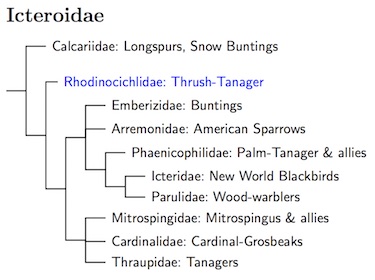
It is not a typo, but is the ending for an epifamily, a rarely used group between superfamily and family. I've resorted to it here to emphasize that the following families are more closely related to each other than to anything else.
Sibley and Monroe (1990) used the name “Emberizinae” for the remaining species. They were using an absolute measure of genetic distance to separate families and other groups. By the time you get here, everything is closely enough related to fit in a single Sibley-Monroe subfamily. In fact, even all of the nine-primaried oscines end up in the same family!
I use terms such as order and family in an ordinal, not cardinal, fashion. This lets me refer to the Sibley-Monroe “Emberizinae” as an epifamily. However, the correct name is Icteroidae (Vigors, 1825), not Emberizoidae (Brehm, 1828). This gives me a little more headroom, but as you will see below, I'm still running out of levels.
All but two of the families in Icteroidae are restricted to New World. The exceptions are Calcariidae and Emberizidae. The latter may have its origin in the New World, but is restricted to the Old World.
The topology of the remaining Icteroidae families is still unclear. Klicka et al. (2003) had Parulidae sister to Arremonidae, while Barker et al. (2013) give a species tree showing Emberizidae and Arremonidae as sisters, but their concatenated tree shows Emberizidae basal and Arremonidae sister to the blackbird/warbler clade. Klicka et al. (2007) has Emberizidae and Arremonidae sister, with Icteridae sister to that, and Parulidae sister to the rest.
The fact that Barker et al.'s (2013) study was unable to find definitive answers as to how these families are related was not due to lack of trying. They analyzed DNA from 6 genes and every genus in Icteroidae (genera as given by the Howard-Moore checklist (Dickinson, 2003)). Although the standard families were well-supported, this cannot be said about their relationships or inner structure. Moreover, a number of taxa did not consistently fall into any of the standard Icteroidae families: Rhodinocichla, Icteria, Teretistris, Zeledonia, Phaenicophilidae, and Mitrospingidae.
The basic problem seems to be very rapid diversification. All of Icteroidae, about 8% of all bird species, share a recent common ancestor. Barker et al. estimate this ancestor lived roughly 15 million years ago and some of the families date from a mere 10 million years ago. With such recent diversification, issues such as speciation before lineages can sort out make it particularly difficult to reconstruct the actual species tree from inconsistent gene trees. More data will be needed to completely sort this out, and it will probably not happen quickly.
 |
| TiF Icteroidae Phylogeny |
|---|
The TiF list now uses a compromise phylogeny based on Oliveros et al. (2019), Kuhl et al. (2021), and Stiller et al. (2024). The Rosy Thrush-Tanager is basal, and placed in its own family, Rhodinocichlidae. It's followed by clade consisting of the Calcariidae (longspurs) and Emberizidae (Old World buntings and sparrows).
The remainder of the Sibley-Monroe Fringillidae, indeed, of all birds, fall into two clades. The smaller one contains a bit less than 400 species. These are divided into 4 families: the American Sparrows (Arremonidae), a relativity new grouping of Carribean species (Phaenicophilidae), and the New World Blackbirds (Icteridae) and Wood-Warblers (Parulidae). The larger group contains nearly 450 species divided into three families: the Cardinal-Grosbeaks (Cardinalidae), Mitospingus and related tanagers (Mitrospingidae) and the main body of tanagers (Thraupidae). The genus Teretistris is not currently assigned to a family, although it belongs to the blackbird/warbler clade.
Sibley and Monroe treated all these species as a single family because the whole clade is of recent origin. Recent age estimates run from about 14 mya (Stiller et al., 2024) to 18.5 mya (Oliveros et al., 2019) and on to 19.8 mya (Kuhl et al., 2021). We don't treat these birds as members of a single family because to do so hide all the diversity exhibited by over 1,100 species. The families break this group up into more coherent groups. It's still about 100 species per family, compared to less than 40 per family for all the other birds. If 100 per family seems a bit high, we also have subfamilies and tribes.
Rhodinocichlidae: Rosy Thrush-Tanager
1 genus, 1 species
The classification of the Thrush-Tanager has long been an issue. Originally considered an ovenbird by Lesson (Furnarius roseus), Hartlaub placed it in its own genus, Rhodinicichla in 1853. Since then, its classification has varied. It has been considered a type of warbler, wren, or thrasher, with names such as thrush-warbler or wren-warbler. It was eventually recognized as a nine-primaried oscine of some sort. Clark (1913) argued that it was a tanager due to similiarities with Mitrospingus, but we don't consider Mitrospingus to be a tanager. Skutch (1962) suggested it might need its own family. Eisenmann (1962) replied with an analysis meant to convince us that Rhodinocichla is a tanager. In retrospect, Eisenmann's reply is unconvincing due to the fact that many of possibly related birds he mentions are no longer part of Tharupidae.
Barker et al. (2013) is the only paper that analyzes DNA from the Rosy Thrush-Tanager. Their results are rather inconclusive. The species tree places it sister to Calcariidae, although this is rather hard to swallow. The concantenated gene tree puts it sister to the remaining Icteroidae. The mitochondrial tree puts it sister to Thraupidae. Support for any of these options is weak and I was intending to leave it unclassified even though Barker et al. suggest treating it as a separate family, Rhodinocichlidae. The discussions in Clark (1913), Eisenmann (1962), and Skutch (1962) convinced me this really is a unique taxon, and that it deserves family status.
The thrush-tanager's range is somewhat disjoint. Ridgway (1902) considered the Mexican race a distinct species. The Central and South American forms are distinct, and may also be separate species.
- Rosy Thrush-Tanager, Rhodinocichla rosea
The Calcariidae and Emberizidae are sister taxa. The division between them is relatively recent with estimates in our three sources ranging between 10.5 and 14 mya. However, it is the deepest division among the the remaining birds. If we don't consider these to be separate families, we shouldn't separate anything else either.
Calcariidae: Longspurs, Snow Buntings Ridgway, 1901
3 genera, 6 species Not HBW Family
 |
| Calcariidae tree |
|---|
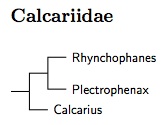
Genetic evidence shows the longspurs and snow buntings are not part of Emberizidae (buntings) or Arremonidae (American sparrows). Rather, they should be placed in their own family, Calcariidae, which is a basal branch in the Icteroidae (Klicka et al., 2003). It was also necessary to revive Rhynchophanes for McCown's Longspur in order to avoid lumping the whole family in one genus. Putting snow buntings and longspurs in one genus just didn't seem right.
The structure as found by Klicka et al. (2003) is that Rhynchophanes and Plectrophenax are sister genera, and the two together are sister to Calcarius. Maley and Wink (2010) found that McKay's Bunting, Plectrophenax hyperboreus, has only recently separated from Snow Bunting, Plectrophenax nivalis, apparently during the last glaciation. There's evidence that its population was once much larger, possibly being widespread in Beringia.
- McCown's Longspur, Rhynchophanes mccownii
- Snow Bunting, Plectrophenax nivalis
- McKay's Bunting, Plectrophenax hyperboreus
- Lapland Longspur, Calcarius lapponicus
- Smith's Longspur, Calcarius pictus
- Chestnut-collared Longspur, Calcarius ornatus
Buntings and Sparrows
Emberizidae: Buntings Brehm, 1828
15 genera, 44 species HBW-16
The name Emberizidae is often attributed to Vigors (1825), but he did not establish the term. The attribution seems to be based on his use of a plural form of Emberiza (Emberizae), which was not used as a family-group name (Olson, 1995).
Emberizidae is sometimes attributed to Brehm, 1831. However, Laurent Raty found it used by Brehm in Isis von Oken vol. 28, Heft XII, p. 1828. Although Brehm attributes the name to Vigors, there is no citation. In 1831, in his “Handbuch der Naturgeschichte aller Vogel Deutschlands”, Brehm attributed it to Vigors in the text (p.289), but to Boie in the index (p.1049). I'm guessing these all refer to the use of Emberizae mentioned above, so I attribute Emberizidae to Brehm, 1828.
 |
| Click for species-level tree for Emberizidae |
|---|
There is some uncertainty concerning whether the Emberiza buntings and American sparrows are even sister clades. For example, Klicka et al. (2003) has Emberizidae embedded in the Icteridae while Arremonidae is sister to Parulidae. Barker et al. (2015, pg. 335) note that although the combined analysis shown on their tree has them as sister taxa, “nuclear genes place Emberizidae outside of a monophyletic New World radiation”. Even if they are sister taxa, they are fairly long-separated (for nine-primaried oscines), which is sufficient reason to place them in separate families.
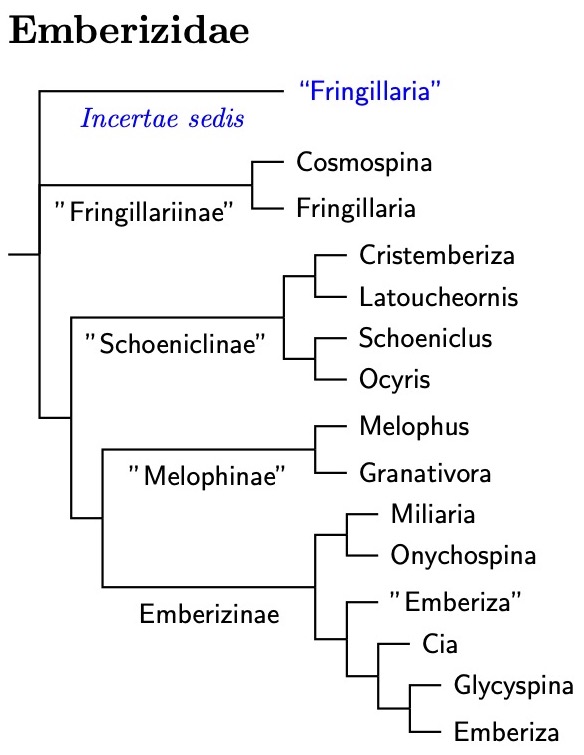
The phylogeny of Emberizidae is now based on Cai et al. (2021) rather than Päckert et al. (2020b) or Päckert et al. (2015). Cai et al. use more genes. The major clades are similar to those found by Alström et al. (2008a) and the adjustments based on Ren et al. (2014) and Schweizer and Kirwan (2014). Although the main clades are the same in the two Päckert et al. papers as in Cai et al., their arrangement is a bit different.
Genera Become Subfamilies
Dickinson and Christidis (H&M-4, 2014) treated the major clades as separate genera. With better timing data, I've now gone beyond that. They have become subfamilies. Of them, only Emberizinae has a name under ICZN rules. I'm using the informal terms Melophinae, Fringillariinae, and Schoeniclinae for the other three. Other than the loss of the Brown-rumped Bunting to incertae sedis, all four subfamilies have the same composition as they previously had. However, their order now follows Cai et al. (2021), which used more genes in their analysis.
… and are split into Genera
With genera becoming subfamilies, more genera are in order. The generic divisions are based on three principles. They must be (1) based on the phylogeny, (2) roughly 5-10 million years old, and (3) form groups that are as coherent as possible. This involved adding 11 genera. Three lack names, and have been given temporary designations in quotes. Here are the new genera, in alphabetical order:
- Cia: Jankowski's Bunting, Emberiza jankowskii, through Godlewski's Bunting, Emberiza godlewskii, are transferred from Emberiza to Cia (Kaup 1829, type cia).
- Cosmospina: Cabanis's Bunting, Fringillaria cabanisi, Golden-breasted Bunting, Fringillaria flaviventris, and Somali Bunting Fringillaria poliopleura, are transferred from Fringillaria to Cosmospina (Wolters 1972, type flaviventris).
- Cristemberiza: Yellow-throated Bunting, Schoeniclus elegans, is transferred to Cristemberiza (Momiyama 1928, monotypic).
- "Emberiza": Tibetan Bunting, Emberiza koslowi, is transferred from Emberiza to "Emberiza".
- Glycyspina: Gray-necked Bunting, Emberiza buchanani, through Cretzschmar's Bunting, Emberiza caesia, are transferred from Emberiza to Glycyspina (Cabanis 1851, type hortulana).
- Granativora: Black-headed Bunting, Melophus melanocephalus, and Red-headed Bunting, Melophus bruniceps, are transferred from Melophus to Granativora (GR Gray, 1855, type melanocephalus).
- Latoucheornis: Slaty Bunting, Schoeniclus siemsseni, is transferred to Latoucheornis (Bangs 1931, monotypic).
- "Melophus": Brown-rumped Bunting, Melophus affinis, is transferred from Melophus to "Melophus".
- Miliaria: Corn Bunting, Emberiza calandra, is transferred from Emberiza to Miliaria (Brehm 1828, monotypic).
- Onychospina: Chestnut-eared Bunting, Emberiza fucata, is transferred from Emberiza to Onychospina (Gray 1855). I had originally moved it to Spina (Kaup 1829, monotypic), but the type of Spina seems unidentifiable, making the name invalid.
- Ocyris: Rustic Bunting, Schoeniclus rustica, through Gray Bunting, Schoeniclus variabilis, are transferred to Ocyris (Hodgson 1845, type pusillus) as the type of Orospina (Kaup 1829) is unidentifiable, making Orospina invalid.
The genera are in general agreement with the morphological groups of Byers et al. (1995). Their Yellowhammer group is genus Emberiza; the Rock Bunting group is Cia; the Ortolan Bunting group is Glycyspina; the Golden-breasted bunting group is Polymitra the House Bunting group is a clade within Fringillaria; the Reed Buntings are Schoeniclus. Not all of Byers et al.'s species groups are supported.
The Brown-rumped Bunting, incertae sedis
The Brown-rumped Bunting has been left incertae sedis. The basic problem is that neither Cai et al. (2021) nor any other paper had sufficient reliable DNA to accurately place it on the tree.
Although various sequences have been analyzed as if they belong to this species, it seems that only the cytochrome-b actually does. It was used by separately by Laurent Raty (BirdForum) and Päckert et al. (2020b), with conflicting results.
That said, there is no reason to think it is not an Emberizid, and it is most likely is near Fringillaria. As a result, I'm now calling the Brown-rumped Bunting "Fringillaria" affinis.
Splits and Lumps
Gosling's Bunting: Gosling's Bunting, Fringillaria goslingi, was previously split from Cinnamon-breasted Bunting, Fringillaria tahapisi. See Olsson et al. (2013b).
Sharpe's Bunting: Päckert et al. (2015) found that Godlewksi's bunting included two different taxa. Specifically, the southern Godlewski's grouped with the Rock Bunting (C. cia), while the northern Godlewski's grouped with the the Meadow Bunting (C. cioides), a result that was not supported by all genes. The name Cia yunnanensis (Sharpe, 1902) applies to the southern group, which I have split as Sharpe's Bunting. They thought that the subspecies khamensis also belongs in this group.
Li et al. (2023) have examined the situation in more detail, with broad sampling. They also found two groups, which we can call godlewskii and yunnanensis. However, the northern group appeared closest to cia, with the southern yunnanensis sister to the pair. Moreover, the yunnanensis group included both khamensis and some members of omissa from Sichuan, to which the name styani applies.
Sharpe's Bunting, Emberiza yunnanensis, now includes khamensis and styani, while Godlewski's Bunting, Cia godlewskii, includes the subspecies decolorata and omissa (minus styani). HBW uses the name Yunnan Bunting for Sharpe's Bunting, but this doesn't really reflect its range, which is much larger (see Figure 1 in Li et al., 2023).
Vincent's Bunting: I continue to treat Vincent's Bunting, Fringillaria vincenti, as a subspecies of the Cape Bunting, Cape Bunting, Fringillaria capensis. I note that the IOC has decided to lump them.
Emberizidae (Buntings) Species List Brehm, 1828
Incertae sedis
- Brown-rumped Bunting, "Fringillaria" affinis
"Fringillariinae" Informal
- Cabanis's Bunting, Cosmospina cabanisi
- Golden-breasted Bunting, Cosmospina flaviventris
- Somali Bunting, Cosmospina poliopleura
- Cape Bunting, Fringillaria capensis
- Socotra Bunting, Fringillaria socotrana
- House Bunting, Fringillaria sahari
- Striolated Bunting, Fringillaria striolata
- Lark-like Bunting, Fringillaria impetuani
- Gosling's Bunting, Fringillaria goslingi
- Cinnamon-breasted Bunting, Fringillaria tahapisi
Emberizinae Brehm, 1828
- Corn Bunting, Miliaria calandra
- Chestnut-eared Bunting, Onychospina fucata
- Tibetan Bunting, "Emberiza" koslowi
- Jankowski's Bunting, Cia jankowskii
- Rock Bunting, Cia cia
- Sharpe's Bunting, Cia yunnanensis
- Meadow Bunting, Cia cioides
- Godlewski's Bunting, Cia godlewskii
- Gray-necked Bunting, Glycyspina buchanani
- Cinereous Bunting, Glycyspina cineracea
- Ortolan Bunting, Glycyspina hortulana
- Cretzschmar's Bunting, Glycyspina caesia
- Cirl Bunting, Emberiza cirlus
- White-capped Bunting, Emberiza stewarti
- Yellowhammer, Emberiza citrinella
- Pine Bunting, Emberiza leucocephalos
"Melophinae" Informal
- Crested Bunting, Melophus lathami
- Black-headed Bunting, Granativora melanocephala
- Red-headed Bunting, Granativora bruniceps
"Schoeniclinae" Informal
- Yellow-throated Bunting, Cristemberiza elegans
- Slaty Bunting, Latoucheornis siemsseni
- Ochre-rumped Bunting / Japanese Reed-Bunting, Schoeniclus yessoensis
- Reed Bunting / Common Reed-Bunting, Schoeniclus schoeniclus
- Pallas's Bunting / Pallas's Reed-Bunting, Schoeniclus pallasi
- Rustic Bunting, Ocyris rusticus
- Little Bunting, Ocyris pusillus
- Yellow-breasted Bunting, Ocyris aureolus
- Chestnut Bunting, Ocyris rutilus
- Black-faced Bunting, Ocyris spodocephalus
- Yellow Bunting, Ocyris sulphuratus
- Yellow-browed Bunting, Ocyris chrysophrys
- Tristram's Bunting, Ocyris tristrami
- Gray Bunting, Ocyris variabilis
Arremonidae: American Sparrows Cabanis & Heine, 1850-51
30 genera, 143 species HBW-16 (split)
The name Arremonidae (Lafresnaye 1842) has priority over the currently used Passerellidae (Cabanis and Heine 1850-51). I had previously used Passerellidae since Bock (1994) incorrectly attributed Arremonidae to Sundevall 1872, which would give Passerellidae priority. However, Bock missed Lafresnaye's use of Arremoninae as a subfamily name.
 |
| Click for genus-level tree for Arremonidae |
|---|
Restructuring
The sparrow family has been carved up in the ongoing reorganization of the nine-primaried oscines. Most of the Neotropical finches have joined the tanagers. The Gubernatrix and Paroaria cardinals have been moved to the tanagers. The Neotropical finches that remain are the Atlapetes brushfinches, as well as the Large-footed, Yellow-thighed, and Yellow-green Finches (Pezopetes and Pselliophorus. In return, the sparrows gain the genus Chlorospingus (excepting flavovirens) and the Tanager Finch, Oreothraupis arremonops. These changes alone would reduce the family to about half its former size, but there is more. They also lose the Emberiza.
Eight Clades in Seven Tribes
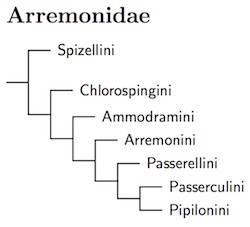
What remains is a somewhat more homogeneous family and it is possible to give it a coherent organization. Everything seems to fall into 8 clades, most of which I've treated at the tribe level (I have united two of them). I haven't used subfamilies partly because I don't think it's clear yet how the tribes fit together, and because the divisions are not particularly deep (7-9 million years ago according to Barker et al., 2015).
Although their correct arrangement was previously unclear, Bryson et al. (2016) mostly resolves the order of the tribes in Arremonidae. The position of Chlorospingini is a little uncertain, but probably correct.
We will consider each of the tribes in turn: Spizellini, Chlorospingini, Ammodramini, Arremonini, Passerellini, Passerculini, and Pipilonini.
Spizellini
As shown by Carson and Spicer (2003), this clade includes most of the Spizella sparrows. The genus Amphispiza is restricted to the Five-striped Sparrow and the Black-throated Sparrow, but does not include the sage sparrows which have been moved to Artemisiospiza in Passerculini Informal. The arrangement within Spizella now follows Barker et al. (2015) instead of Canales-Del Castillo et al. (2010) and Klicka et al. (2014), who both had Brewer's Sparrow somewhat surprisingly sister to Worthen's Sparrow. Having Field Sparrow sister to Brewer's is only a bit less surprising, but makes more biogeographic sense. Presumably, the similarities between Field and Worthen's Sparrows derive from their common ancestor. The Timberline Sparrow, Spizella breweri taverneri, is sometimes thought to be a separate species. Although there is some differentiation between it and Brewer's Sparrow, it may be best thought of as an incipient species within Brewer's Sparrow. See Klicka et al. (1999, 2014) and Barker et al. (2015).
Chlorospingini consists of Chlorospinus and the Tanager Finch (Oreothraupis) Although it had been suggested that the Tanager Finch belongs with the Atlapetes Brushfinches, Barker et al. (2013) found it sister to Chlorospingus. The treatment of the Common Chlorospingus complex is based on García-Moreno et al. (2004), Sánchez-González et al. (2007), Bonaccorso et al. (2008), and Weir et al. (2008). This involves breaking up the Common Chlorospingus into 9 species. Four of these are primarily Mexican: White-fronted Chlorospingus, C. albifrons; Wetmore's Chlorospingus, C. wetmorei; Brown-headed Chlorospingus, C. ophthalmicus; and Dwight's Chlorospingus, C. dwighti. The color plate in Sánchez-González et al. (2007) illustrates these forms as well as Dusky-headed Chlorospingus, C. postocularis. Other taxa that appear to deserve species status are the Central American Dotted Chlorospingus, C. punctulatus; the Buff-breasted Chlorospingus, C. cinereocephalus, of Peru; and the Yellow-breasted Chlorospingus, C. flavopectus. The list of subspecies below presumes that Isler and Isler's (1987) flavopectus group stays together, although only two of its subspecies were analyzed by Weir et al. (2008). I've also presumed that Isler and Isler's venezuelanus group stays together. Weir found that some of them group with several more southern races. For the present, it seems reasonable to put the whole lot of them in a single species and call it Common Chlorospingus, C. venezuelanus. There may still be additional species hiding within the Common Chlorospingus complex.
| The Common Chlorospingus Complex | ||
|---|---|---|
| Species | Subspecies | Location |
| Wetmore's Chlorospingus | wetmorei | Mexico: Sierra de Tuxtla |
| White-fronted Chlorospingus | albifrons, persimilis | Mexico: Sierra Madre del Sur |
| Brown-headed Chlorospingus | ophthalmicus | Mexico: Sierra Madre Oriental |
| Dwight's Chlorospingus | dwighti | Mexico: Chiapas, Caribbean slope |
| Dusky-headed Chlorospingus | postocularis, honduratius | Chiapas, Pacific slope; Guatemala, Honduras, El Salvador |
| Dotted Chlorospingus | punctulatus, regionalias, ‘novicius’* | Nicaragua, Costa Rica, W. Panama |
| Common Chlorospingus | venezuelanus*, jacqueti, falconensis*, ponsi*, eminens*, peruvianus, bolivianus, fulvigularis, argentinus | E. Colombia, Venezuela, S. Peru, Bolivia, Argentina |
| Buff-breasted Chlorospingus | cinereocephalus | C. Peru |
| Tacarcuna Chlorospingus | tacarcunae | E. Panama |
| Pirre Chlorospingus | inornatus | Darién (Panama, Colombia) |
| Yellow-breasted Chlorospingus | flavopectus*, trudis*, exitelis*, macarenae*, nigriceps*, phaeocephalus, hiaticolus | Colombia, Ecuador, N. Peru |
| Dusky Chlorospingus | semifuscus, livingstoni* | W. Colombia, W. Ecuador |
| Subspecies based on Dickinson et al. (2003). *An asterisk indicates taxa not sampled by Weir et al. (2008). The subspecies ‘novicius’ may be a hybrid form. | ||
Ammodramini
The phylogeny of Ammodramini is a particular problem. Indeed, Bryson et al.'s Figure 2B (2016) has it totally unresolved. I have followed Figure 2A which does resolve it, but with weak support. Barker et al. (2015) is similar but with Ammodrammus basal. Additionally, some genera in Ammodramini have required reorganization. Ammodramus and Aimophila have been affected the most. The papers by Klicka and Spellman (2007) and DaCosta et al. (2009) show what to do. Ammodramus itself is reduced to the Grasshopper Sparrow together with a couple of Neotropical relatives—Grassland and Yellow-browed Sparrows. These are sister to a big chunk of what was Aimophila. As the Aimophila type species has moved to Pipilonini, I have revived Audubon's 1839 name for them, Peucaea (type aestivalis). Two more of the former Aimophila are sister to Arremonops. Following DaCosta et al.'s suggestion, they take the genus name Rhyncospiza (Ridgway 1898, type stolzmanni).
Arremonini
Arremonini consists of a number of Neotropical sparrows. In fact, the size of this group has grown due to the splitting of Buarremon torquatus. I had merged all of these into Arremon, but the dated tree in Barker et al. (2015) has convinced me to restore the genera Lysurus and Buarremon. The basal group of 4 becomes Lysurus. Two of these were in Lysurus in H&M-3, while the other two were in Buarremon.
The tree follows Barker et al. (2015), which is similiar to Klicka et al. (2014). Previous analyses were less clear (see Cadena et al., 2007; Flórez-Rodríguez et al., 2011).
The four Lysurus species include the brunneinucha/virenticeps complex, which may actually hide a half-dozen species (Navarro-Sigüenza et al., 2007). These are followed by the Arremon sparrows. The former Stripe-headed Brushfinch, Buarremon torquatus, has been split into 8 species (Cadena et al., 2007, 2010, 2011; also see SACC proposal #468). The split of the Stripe-headed Brushfinch (torquatus group) is detailed below. The English names follows AOU's NACC and SACC
| The Stripe-headed Brushfinch Complex | ||
|---|---|---|
| Species | Subspecies | Location |
| Costa Rican Brushfinch | costaricensis | Costa Rica, W Panama |
| Gray-browed Brushfinch | assimilis, larensis, nigrifrons, poliophrys | Andes of Venezuela, Colombia, Ecuador, Peru |
| Sierra Nevada Brushfinch | basilicus | Santa Marta Mountains |
| Perija Brushfinch | perijanus | E Colombia to W Venezuela |
| White-browed Brushfinch | torquatus, fimbriatus, borelli | extreme S Peru, Bolivia, Argentina |
| Black-headed Brushfinch | atricapillus, tacarcunae | C & E Panama, Colombian Andes |
| Caracas Brushfinch | phaeopleurus | Coastal mountains of N Venezuela |
| Paria Brushfinch | phygas | NE Venezuela |
Passerellini
The Junco/Zonotrichia clade Passerellini is first. It is now clear that the American Tree Sparrow is not part of Spizella. Rather, it is most closely related to the Fox Sparrow, Passerella iliaca (Carson and Spicer, 2003). Slager and Klicka (2014a) established the new genus Spizelloides for it. The Passerella/Spizelloides group forms a clade with the juncos and Zonotrichia. Passerella iliaca itself remains controversial, and may end up being split into four species. The Guadalupe Junco, Junco insularis, has been split from J. hyemalis (it is actually sister to hyemalis + phaeonotus, see Klicka et al., 2014). and Baird's Junco, Junco bairdi, has been split from the Yellow-eyed Junco, Junco phaeonotus (AOS 58th Supplement). The phylogeny follows Friis et al., 2016), where Baird's Junco is not even sister to the Yellow-eyed Junco.
Passerculini
The Passerculini are not well-resolved by Bryson et al. (2016). I have modified Klicka et al.'s (2014) treatment to take both Bryson et al. and Barker et al. (2015) into account.
The Passerculini open with a clade containing the Vesper Sparrow and two former Amphispiza, the sage sparrows. The sage sparrows get a brand new genus name. Klicka and Spellman (2007) discovered that it is not related to the other Amphispiza. The name they proposed, Artemisospiza, did not strictly follow ICZN rules. In view of this, Klicka and Banks (2011) proposed the name Artemisiospiza (think sagebrush, Artemesia). Moreover, the AOU, after considering Cicero and Koo (2012), now treats the Sage Sparrow as two species: Bell's Sparrow, Artemisiospiza belli, and Sagebrush Sparrow, Artemisiospiza nevadensis. The situation is rather confusing and a third species may be involved.
The Striped Sparrow is next, with the remainder falling into two clades. The first consists of the “marshland” Ammodramus. As Klicka and Spellman (2007) recommend, they get the name Ammospiza.
The remaining clade is rather difficult. Klicka et al. (2014) and Barker et al. (2015) give conflicting results, and Bryson et al. (2016) only include two taxa. Taking the dating of Barker et al. (2015) into account, these should be treated as no more than two genera. Using Klicka et al.'s (2014) tree, Centronyx (Henslow's and Baird's Sparrows) has been merged into Passerculus, and Xenospiza has been merged into Melospiza. Barker et al. (2016) give a somewhat different topology, but I just don't see Baird's and Sierra Madre Sparrows as sister species, while Baird's and Henslow's sister and related to Savannah Sparrow as in Klicka et al. (2014) makes a lot of sense. Of course, that's no guarantee that it is correct!
Pipilonini
That brings us to Pipilonini. Exactly how these genera relate is not entirely clear. The overall arrangement is based on Figure A of Byrson et al. (2016), except that I have doubts about where Pezopetes (and presumably Torreornis, based on Barker et al., 2015) goes. I'm treating it as part of a basal trichotomy, with Melozone-Aimophila-Kieneria and Atlapetes-Pipilo. Nonetheless, the position of Pezopetes and Torreornis is also uncertain. Klicka et al. (2014) had them weakly attached to the Melozone-Aimophila-Kieneria clade. Barker et al. (2015) found them in a clade sister to Pipilo.
The arrangement of Aimophila, Kieneria, and Melozone has been adjusted using information from Sandoval et al. (2017).
Previously, DaCosta et al. (2009) resolved a big chunk of the uncertainty concerning the Pipilonini. They found that the Melozone Ground-Sparrows end up in two (or three?) separate groups. Based on Baker et al. (2015) and Bryson et al. (2016), three groups in a trichotomy seems the best choice. One group is the White-eared and Prevost's Ground-Sparrows, which keep the genus name Melozone (type biarcuata). It is not clear whether they are closer to Aimophila or to Kieneria as in Barker et al. (2015) or basal to both as in Bryson et al. (2016) Figure 2B. I have based the current treatment on Sandoval et al. (2017), but some uncertainties still remain.
Based on Sandoval et al. (2017) and the HBW BirdLife Checklist (del Hoyo and Collar, 2016) I have split Gray-crowned Ground-Sparrow, Melozone occipitalis, from White-eared Ground-Sparrow, Melozone leucotis (inc. nigrior) and with the further assistance of Sandoval (2014) split Cabanis's Ground-Sparrow, Melozone cabanisi, from Prevost's Ground-Sparrow, Melozone biarcuata (inc. hartwegi).
A second group consists of the remaining Aimophila sparrows. The third group includes the brown towhees. DaCosta et al. suggest the genus name Pyrgisoma for it. The AOU proposal suggested the type of Pyrgisoma is kieneri, although Ridgway gives the type as biarcuata. Apparently, treating kieneri as type dates from a time when biarcuata was considered a subspecies of kieneri. However, when separate, kieneri becomes the type species of Kieneria (Bonaparte 1855) and biarcuata is the type of Pyrgisoma. Since biarcuata ends up in the genus Melozone, which has priority, it cannot be used. Thus Kieneria is the name used here. The brown towhees have always been considered different, and there have been suggestions they should get their own genus. That has never happened, so my best option seems to be to put them into Kieneria too.
The rest of the Pipilonini consists of the Pipilo towhees together with the Atalapetes brushfinches and allies. The extinct Bermuda Towhee, Pipilo naufragus, has been included as it seems to have survived into historical times. See Olson and Wingate (2012).
The Pselliophorus finches are embedded in Atlapetes, and I have accordingly changed their scientific names. Klicka et al. (2014) and Barker et al. (2015) present a comprehensive molecular phylogeny of Atlapetes which includes almost all of the Atlapetes species. The linear order is based on their phylogeny. One species they left out was the Black-faced Brushfinch, Atlapetes melanolaemus. Its position is based on Sánchez-González et al. (2015).
Based on Sánchez-González et al. (2015), the Choco Brushfinch, Atlapetes crassus (Colombia and Ecuador) has been split from Tricolored Brushfinch, Atlapetes tricolor (Peru), and Taczanowski's Brushfinch, Atlapetes taczanowskii (Peru), has been split from Slaty Brushfinch, Atlapetes schistaceus (Colombia, Ecuador, and Venezuela).
Based on Donegan et al. (2014a), Merida Brushfinch, Atlapetes meridae, has been split from Moustached Brushfinch, Atlapetes albofrenatus, and Black-fronted Brushfinch, Atlapetes nigrifrons, has been split from Yellow-breasted Brushfinch, Atlapetes latinuchus. A further split from A. latinuchus may be needed, but it is not yet clear how that will work.
Spizellini Baird, 1858
- Lark Sparrow, Chondestes grammacus
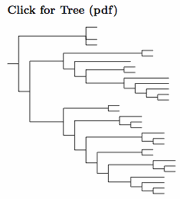
Click for species-level
Arremonidae tree - Lark Bunting, Calamospiza melanocorys
- Black-throated Sparrow, Amphispiza bilineata
- Five-striped Sparrow, Amphispiza quinquestriata
- Chipping Sparrow, Spizella passerina
- Black-chinned Sparrow, Spizella atrogularis
- Clay-colored Sparrow, Spizella pallida
- Worthen's Sparrow, Spizella wortheni
- Brewer's Sparrow, Spizella breweri
- Field Sparrow, Spizella pusilla
Chlorospingini Informal
- Tanager Finch, Oreothraupis arremonops
- Short-billed Chlorospingus / Yellow-whiskered Bush-Tanager, Chlorospingus parvirostris
- Yellow-throated Chlorospingus, Chlorospingus flavigularis
- Ashy-throated Chlorospingus, Chlorospingus canigularis
- Sooty-capped Chlorospingus, Chlorospingus pileatus
- Wetmore's Chlorospingus, Chlorospingus wetmorei
- White-fronted Chlorospingus, Chlorospingus albifrons
- Brown-headed Chlorospingus, Chlorospingus ophthalmicus
- Dwight's Chlorospingus, Chlorospingus dwighti
- Dusky-headed Chlorospingus, Chlorospingus postocularis
- Dotted Chlorospingus, Chlorospingus punctulatus
- Common Chlorospingus, Chlorospingus venezuelanus
- Buff-breasted Chlorospingus, Chlorospingus cinereocephalus
- Tacarcuna Chlorospingus, Chlorospingus tacarcunae
- Pirre Chlorospingus, Chlorospingus inornatus
- Yellow-breasted Chlorospingus, Chlorospingus flavopectus
- Dusky Chlorospingus, Chlorospingus semifuscus
Ammodramini: Grassland Sparrows Ridgway, 1901
- Tumbes Sparrow, Rhynchospiza stolzmanni
- Stripe-capped Sparrow, Rhynchospiza strigiceps
- Olive Sparrow, Arremonops rufivirgatus
- Green-backed Sparrow, Arremonops chloronotus
- Black-striped Sparrow, Arremonops conirostris
- Tocuyo Sparrow, Arremonops tocuyensis
- Grasshopper Sparrow, Ammodramus savannarum
- Grassland Sparrow, Ammodramus humeralis
- Yellow-browed Sparrow, Ammodramus aurifrons
- Rufous-winged Sparrow, Peucaea carpalis
- Cinnamon-tailed Sparrow, Peucaea sumichrasti
- Botteri's Sparrow, Peucaea botterii
- Cassin's Sparrow, Peucaea cassinii
- Bachman's Sparrow, Peucaea aestivalis
- Stripe-headed Sparrow, Peucaea ruficauda
- Black-chested Sparrow, Peucaea humeralis
- Bridled Sparrow, Peucaea mystacalis
Arremonini: Scrub Sparrows Sundevall, 1872
- Sooty-faced Finch, Lysurus crassirostris
- Olive Finch, Lysurus castaneiceps
- Green-striped Brushfinch, Lysurus virenticeps
- Chestnut-capped Brushfinch, Lysurus brunneinucha
- Orange-billed Sparrow, Arremon aurantiirostris
- Black-capped Sparrow, Arremon abeillei
- Golden-winged Sparrow, Arremon schlegeli
- Saffron-billed Sparrow, Arremon flavirostris
- Pectoral Sparrow, Arremon taciturnus
- Sao Francisco Sparrow, Arremon franciscanus
- Half-collared Sparrow, Arremon semitorquatus
- Costa Rican Brushfinch, Buarremon costaricensis
- Caracas Brushfinch, Buarremon phaeopleurus
- Black-headed Brushfinch, Buarremon atricapillus
- Paria Brushfinch, Buarremon phygas
- Gray-browed Brushfinch, Buarremon assimilis
- White-browed Brushfinch, Buarremon torquatus
- Sierra Nevada Brushfinch, Buarremon basilicus
- Perija Brushfinch, Buarremon perijanus
Passerellini: Juncos and allies Cabanis & Heine, 1850-51
- American Tree Sparrow, Spizelloides arborea
- Fox Sparrow, Passerella iliaca
- Volcano Junco, Junco vulcani
- Baird's Junco, Junco bairdi
- Guadalupe Junco, Junco insularis
- Dark-eyed Junco, Junco hyemalis
- Yellow-eyed Junco, Junco phaeonotus
- Rufous-collared Sparrow, Zonotrichia capensis
- Harris's Sparrow, Zonotrichia querula
- White-throated Sparrow, Zonotrichia albicollis
- Golden-crowned Sparrow, Zonotrichia atricapilla
- White-crowned Sparrow, Zonotrichia leucophrys
Passerculini Informal
- Vesper Sparrow, Pooecetes gramineus
- Bell's Sparrow, Artemisiospiza belli
- Sagebrush Sparrow, Artemisiospiza nevadensis
- Striped Sparrow, Oriturus superciliosus
- Le Conte's Sparrow, Ammospiza leconteii
- Seaside Sparrow, Ammospiza maritima
- Nelson's Sparrow, Ammospiza nelsoni
- Saltmarsh Sparrow, Ammospiza caudacuta
- Savannah Sparrow, Passerculus sandwichensis
- Baird's Sparrow, Passerculus bairdii
- Henslow's Sparrow, Passerculus henslowii
- Sierra Madre Sparrow, Melospiza baileyi
- Lincoln's Sparrow, Melospiza lincolnii
- Song Sparrow, Melospiza melodia
- Swamp Sparrow, Melospiza georgiana
Pipilonini: Towhees & BrushfinchesBonaparte, 1854
- Zapata Sparrow, Torreornis inexpectata
- Large-footed Finch, Pezopetes capitalis
- Rusty-crowned Ground-Sparrow, Kieneria kieneri
- White-throated Towhee, Kieneria albicollis
- California Towhee, Kieneria crissalis
- Abert's Towhee, Kieneria aberti
- Canyon Towhee, Kieneria fusca
- Rusty Sparrow, Aimophila rufescens
- Rufous-crowned Sparrow, Aimophila ruficeps
- Oaxaca Sparrow, Aimophila notosticta
- Gray-crowned Ground-Sparrow, Melozone occipitalis
- White-eared Ground-Sparrow, Melozone leucotis
- Prevost's Ground-Sparrow, Melozone biarcuata
- Cabanis's Ground-Sparrow, Melozone cabanisi
- Collared Towhee, Pipilo ocai
- Green-tailed Towhee, Pipilo chlorurus
- Spotted Towhee, Pipilo maculatus
- Eastern Towhee, Pipilo erythrophthalmus
- Bermuda Towhee, Pipilo naufragus
- Rufous-capped Brushfinch, Atlapetes pileatus
- White-naped Brushfinch, Atlapetes albinucha
- Yellow-thighed Finch, Atlapetes tibialis
- Yellow-green Finch, Atlapetes luteoviridis
- Tepui Brushfinch, Atlapetes personatus
- Black-spectacled Brushfinch, Atlapetes melanopsis
- Choco Brushfinch, Atlapetes crassus
- Apurimac Brushfinch, Atlapetes forbesi
- Black-faced Brushfinch / Gray-eared Brushfinch, Atlapetes melanolaemus
- Cuzco Brushfinch, Atlapetes canigenis
- Vilcabamba Brushfinch, Atlapetes terborghi
- Bolivian Brushfinch, Atlapetes rufinucha
- Fulvous-headed Brushfinch, Atlapetes fulviceps
- Yellow-striped Brushfinch, Atlapetes citrinellus
- Moustached Brushfinch, Atlapetes albofrenatus
- Merida Brushfinch, Atlapetes meridae
- Black-fronted Brushfinch, Atlapetes nigrifrons
- Santa Marta Brushfinch, Atlapetes melanocephalus
- Ochre-breasted Brushfinch, Atlapetes semirufus
- White-headed Brushfinch, Atlapetes albiceps
- White-rimmed Brushfinch, Atlapetes leucopis
- Yellow-headed Brushfinch, Atlapetes flaviceps
- Dusky-headed Brushfinch, Atlapetes fuscoolivaceus
- Rufous-eared Brushfinch, Atlapetes rufigenis
- Tricolored Brushfinch, Atlapetes tricolor
- Slaty Brushfinch, Atlapetes schistaceus
- Taczanowski's Brushfinch, Atlapetes taczanowskii
- Pale-naped Brushfinch, Atlapetes pallidinucha
- Yellow-breasted Brushfinch, Atlapetes latinuchus
- White-winged Brushfinch, Atlapetes leucopterus
- Pale-headed Brushfinch, Atlapetes pallidiceps
- Bay-crowned Brushfinch, Atlapetes seebohmi
- Rusty-bellied Brushfinch, Atlapetes nationi
- Antioquia Brushfinch, Atlapetes blancae