Oscines: Passeri Linnaeus, 1766
Although the oscines and suboscines are readily identified, the proper classification of the oscines remained obscure for a long time. Sibley, Ahlquist, and Monroe took the first step by gathering the corvids together (albeit imperfectly). Their idea was that the oscines divided into two large groups, Corvida and Passerida. Their efforts were reflected in innovative checklists such as Gill's family list (1995) and the 3rd edition Howard-Moore checklist, both of which did a lot to group these birds into reasonable families. Contemporary checklists of a more traditional sort, such as Clements 5th edition placed the members of the corvid assemblage all over the map.
Sibley and Ahlquist's view was that the remaining passerines split cleanly into a corvid group (Corvida) and a group containing everything else (Passerida). Further study has shown that reality is more complex. Unlike the Passerida, their version of the corvids was not a monophyletic group. Rather, their Corvida included a number of basal oscines as well as some basal Passerida. Nonetheless, further analysis has revealed a core group (Corvida) that is sister to the Passerida.
Basal Oscines
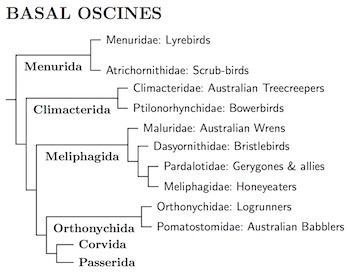
The Basal Oscines include ten families—Lyrebirds (Menuridae), Scrub-birds (Atrichornithidae), Australasian Treecreepers (Climacteridae), Bowerbirds (Ptilonorhynchidae), Australian Wrens (Maluridae), Bristlebirds (Dasyornithidae), Pardalotes (Pardalotidae), Gerygones (Acanthizidae), Honeyeaters (Meliphagidae), Logrollers (Orthonychidae), and Australian Babblers (Pomatostomidae). As the tree indicates, these families are arranged into four separate branches (ranked as parvorders) before we reach the split between the Corvida and Passerida (see Ericson et al., 2002a; Barker et al., 2004; Irestedt and Ohlson, 2008). The current arrangement is supported by all of the dated phylogenies from big three papers, meaning Oliveros et al. (2019), Kuhl et al. (2021), and Stiller et al. (2024). Except for the fact that Kuhl et al. omitted two of the families, they are in complete agreement concerning both the phylogeny and ages of the various groups. If you click on the tree, you'll get a version with average ages from the big three.
 |
| Click for dated phylogeny of Basal Oscines |
|---|
It is striking how the initial oscine radiation was confined to Australasia. We see this in the distribution of the basal oscines. All of the Menurida, Climacterida, and Pomatostomida are Australasian. Only Meliphagida has any species outside the area. Even there, two of the four families (Maluridae and Dasyornithidae) are also entirely Australasian. Further, only one of Acanthizidae crosses Wallace's line—the Golden-bellied Gerygone. That leaves the Meliphagidae, which have spread widely across Australasia and Oceania, with several species coming near Wallace's line. Even so, only one of them, the Indonesian Honeyeater, barely manages to range into Indo-Malaya.
Jønsson et al. (2011b) offers some evidence concerning a possible relation between the emergence of the proto-Papuan archipelago and the oscine radiation. The New Scientist has a summary.
It's now possible to make a reasonable stab at the ages of these families. The big three papers are in agreement about the phylogeny. The estimated ages of the families are fairly consistent, and the ages I use for the families and higher groupings are averages from the big three. Kuhl et al. (2021) did not include Scrub-birds or Bristlebirds in their analysis.
Menurida Sharpe, 1891
The first basal oscine branch, Menurida, is about 37.5 million years old. It is endemic to Australia and consists of two families: the lyrebirds (Menuridae) and scrub-birds (Atrichornithidae). Ericson et al. (2002b) found the Menurida sister to the rest of the oscines, but did not include scrub-birds in his analysis. Morphological analyses had placed the scrub-birds next to the lyrebirds. A genetic analysis by Chesser and ten Have (2007) concurred that the lyrebirds and scrub-birds are sister families, as do the big three. For a discussion of the history of lyrebird and scrub-bird taxonomy, see Ericson et al. (2002b) and Chesser and ten Have (2007), respectively. The lyrebird-scrub-bird split happened about 26.5 mya.
Menuridae: Lyrebirds Lesson, 1828
1 genus, 2 species HBW-9
- Albert's Lyrebird, Menura alberti
- Superb Lyrebird, Menura novaehollandiae
Atrichornithidae: Scrub-birds Stejneger, 1885 (1875)
1 genus, 2 species HBW-9
- Rufous Scrub-bird, Atrichornis rufescens
- Noisy Scrub-bird, Atrichornis clamosus
Climacterida Informal
The parvorders Climacterida, Meliphagida, and Orthonychida don't appear to have been formally named. They tend to be lumped together with Menurida under terms such as “basal Corvida”. Nonetheless, there are 4 distinct basal clades here, and only Menurida has a name. I find it convenient for them all to have names, and have been using the above since 2007.
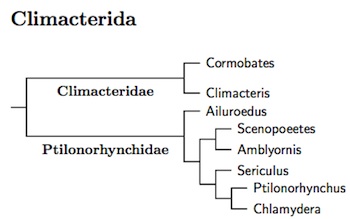 The Climacterida are the second branch. Their branch originated about 37.3
mya. Climacterida includes two families: Australasian treecreepers
(Climacteridae) and bowerbirds (Ptilonorhynchidae). The split between
them happened about 31.6 mya. Both families are endemic to Australasia.
The Climacterida are the second branch. Their branch originated about 37.3
mya. Climacterida includes two families: Australasian treecreepers
(Climacteridae) and bowerbirds (Ptilonorhynchidae). The split between
them happened about 31.6 mya. Both families are endemic to Australasia.
Climacteridae: Australasian Treecreepers de Selys-Longchamps, 1839
2 genera, 7 species HBW-12
There's not a genetic study of the family. Oliveros et al. (2019) estimated the two genera, Cormobates and Climacteris, are separated by about 18.3 mya. Ericson et al. (2020), using different species from the same genera, estimated the split at 16.4 mya. Both estimates are well within each other's error bars. Since the two types of Australasian treecreepers seem similar, I rank both genera as subfamilies, not families.
Climacteris is thought to consist of two superspecies: erythrops + affinis, and rufus, picumnus, and melanurus. E.g., see Sibley and Monroe (1990) and HBW-12.
Cormobatinae
- Papuan Treecreeper, Cormobates placens
- White-throated Treecreeper, Cormobates leucophaea
Climacterinae
- White-browed Treecreeper, Climacteris affinis
- Red-browed Treecreeper, Climacteris erythrops
- Black-tailed Treecreeper, Climacteris melanurus
- Rufous Treecreeper, Climacteris rufus
- Brown Treecreeper, Climacteris picumnus
Ptilonorhynchidae: Bowerbirds & Catbirds G.R. Gray, 1841
7 genera, 28 species HBW-14
 |
| Click for Ptilonorhynchidae species tree |
|---|
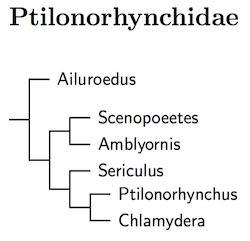
The phylogeny of the Ptilonorhynchidae now follows Ericson et al. (2020). There are two fairly deep divisions in the Ptilonorhynchidae, one at about 15 mya, and another around 12.8 mya. I've treated the first division as creating two subfamilies, and that at 12.8 mya as tribes. The reason for this is to emphasize that the Australasian catbirds are more closely related to some bowerbirds than others.
The two subfamilies are Ptilonorhynchinae, for the bowerbirds that build avenue-type bowers, and Ailuroedinae, which contains the catbirds, the maypole bower builders, and the Tooth-billed Bowerbird, Scenopoeetes dentirostris. The last makes a stage decorated by leaves turned so that all have the same side facing up.
The tribal split is between Amblyornithini and Ailuroedini. Amblyornithini contains the maypole bowerbirds and the Tooth-billed Bowerbird. Ailuroedini consists of the Australasian catbirds. The names Amblyornithini and Ailuroedini were established by Iredale at the same time in 1948. I don't know that anyone has explictly acted as first reviser, but Stresemann (1953) implicitly did so when put the genera of both tribes in the subfamily Ailuroedinae.
I've followed IOC and split the Huon Bowerbird, Amblyornis germanus, from MacGregor's Bowerbird, Amblyornis macgregoriae, IOC had split them based on distinctive bower construction and unspecified DNA differences, citing Beehler and Pratt (2016) and Gregory (2017). They didn't cite Ericson et al. (2020), who provided a dated phylogeny of the bowerbirds. They estimated the split between the two taxa occurred in the early Pleistocene, over 2 mya. This is a strong indication they are separate species.
I previously accepted a number of splits in the Ailuroedus catbirds that were recommended by Irestedt et al. (2016) and adopted by IOC. They are:
- Split Tan-capped Catbird, Ailuroedus geislerorum (inc. molestus Rothschild & Hartert, 1929), and Ochre-breasted Catbird, Ailuroedus stonii (inc. cinnamomeus), from White-eared Catbird, Ailuroedus buccoides.
- Split Spotted Catbird, Ailuroedus melanotis into Spotted Catbird, Ailuroedus maculosus, Huon Catbird, Ailuroedus astigmaticus, Black-capped Catbird, Ailuroedus melanocephalus, Black-eared Catbird, Ailuroedus melanotis (inc. joanae and facialis) Arfak Catbird, Ailuroedus arfakianus (inc. misoliensis), and Northern Catbird, Ailuroedus jobiensis inc. guttaticollis.
Earlier, based on Zwiers et al. (2008), Sericulus ardens, was split from Sericulus aureus. Interestingly, they don't seem to be each other's closest relatives. The name Flame Bowerbird follows S. ardens while S. aureus becomes Masked Bowerbird.
Ptilonorhynchinae: Avenue Bowerbirds G.R. Gray 1841
- Regent Bowerbird, Sericulus chrysocephalus
- Masked Bowerbird, Sericulus aureus
- Flame Bowerbird, Sericulus ardens
- Fire-maned Bowerbird, Sericulus bakeri
- Satin Bowerbird, Ptilonorhynchus violaceus
- Fawn-breasted Bowerbird, Chlamydera cerviniventris
- Yellow-breasted Bowerbird, Chlamydera lauterbachi
- Great Bowerbird, Chlamydera nuchalis
- Western Bowerbird, Chlamydera guttata
- Spotted Bowerbird, Chlamydera maculata
Ailuroedinae: Catbirds Iredale 1948
Amblyornithini: Maypole Bowerbirds Iredale 1948
- Tooth-billed Bowerbird, Scenopoeetes dentirostris
- Golden Bowerbird, Prionodura newtoniana
- Streaked Bowerbird, Amblyornis subalaris
- MacGregor's Bowerbird, Amblyornis macgregoriae
- Huon Bowerbird, Amblyornis germanus
- Archbold's Bowerbird, Amblyornis papuensis
- Vogelkop Bowerbird, Amblyornis inornata
- Golden-fronted Bowerbird, Amblyornis flavifrons
Ailuroedini: Catbirds Iredale 1948
- Tan-capped Catbird, Ailuroedus geislerorum
- White-eared Catbird, Ailuroedus buccoides
- Ochre-breasted Catbird, Ailuroedus stonii
- Spotted Catbird, Ailuroedus maculosus
- Green Catbird, Ailuroedus crassirostris
- Black-capped Catbird, Ailuroedus melanocephalus
- Huon Catbird, Ailuroedus astigmaticus
- Black-eared Catbird, Ailuroedus melanotis
- Arfak Catbird, Ailuroedus arfakianus
- Northern Catbird, Ailuroedus jobiensis
Meliphagida Informal
The large Meliphagida branch split from the rest around 34.1 mya. It contains four families: Australasian wrens (Maluridae), bristlebirds (Dasyornithidae), pardalotes (Pardalotidae), gerygones and allies (Acanthizidae), and honeyeaters (Meliphagidae). The Maluridae spilt around 29.1 mya, the Dasyornithidae about 25.7 mya, the Pardalotidae-Acanthizidae split happened around 21.8 mya, and the Meliphagidae branch dates to roughly 24.8 mya. The pardalotes and gerygones are similar enough that it would not be unreasonable to put both in the same family, and I have sometimes done so. However, it is traditional to split them.
The family arrangement is based on the big three, Oliveros et al. (2019), Kuhl et al. (2021), and Stiller et al. (2025). The Dasyornithidae have sometimes been included in Pardalotidae. However, the DNA shows that the Dasyornithidae form a deep separate branch of the Meliphagida.
Maluridae: Australasian Wrens Swainson, 1831
5 genera, 32 species HBW-12
 |
| Click for Maluridae tree |
|---|
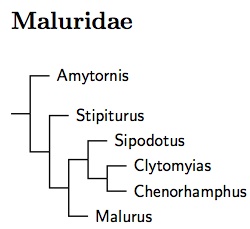
The Maluridae are another family that is restricted to Australia and New Guinea. The arrangement here is based on Marki et al. (2017), and is similar to one previously obtained from Lee et al. (2012), Christidis et al. (2010) (Amytornis), and Driskell et al. (2011) (the other genera).
The two subfamilies are thought to have originated around the end of the Oligocene or beginning of the Miocene (Marki et al., 2017).
Driskell et al. (2011) found that the broad-billed fairywrens were more closely related to Sipodotus and Clytomyias than to the rest of Malurus. They recommend putting them in a separate genus, Chenorhamphus (Oustalet 1878, type grayi), which I have done here.
Although Driskell et al. (2011) found that the Lovely Fairywren, M. amabilis is nested within the Variegated Fairywren, M. lamberti, a more detailed analysis by McLean et al. determined that they are sister species. This is consistent with reports that assimilis interbreeds with lamberti where they meet.
Based on Black et al. (2010) and Christidis et al. (2010), Thick-billed Grasswren, Amytornis textilis, is split into Western Grasswren, Amytornis textilis, and Thick-billed Grasswren, Amytornis modestus.
Based on Christidis et al. (2010, 2013), Pilbara Grasswren, Amytornis whitei, Sandhill Grasswren, Amytornis oweni, and Rusty Grasswren, Amytornis rowleyi, have been split from Striated Grasswren, Amytornis striatus.
Amytornithinae: Grasswrens Mathews, 1946
- Gray Grasswren, Amytornis barbatus
- Short-tailed Grasswren, Amytornis merrotsyi
- White-throated Grasswren, Amytornis woodwardi
- Carpentarian Grasswren, Amytornis dorotheae
- Pilbara Grasswren, Amytornis whitei
- Sandhill Grasswren, Amytornis oweni
- Rusty Grasswren, Amytornis rowleyi
- Striated Grasswren, Amytornis striatus
- Western Grasswren, Amytornis textilis
- Thick-billed Grasswren, Amytornis modestus
- Black Grasswren, Amytornis housei
- Eyrean Grasswren, Amytornis goyderi
- Dusky Grasswren, Amytornis purnelli
- Kalkadoon Grasswren, Amytornis ballarae
Malurinae: Fairywrens Swainson, 1831
- Mallee Emuwren, Stipiturus mallee
- Rufous-crowned Emuwren, Stipiturus ruficeps
- Southern Emuwren, Stipiturus malachurus
- Wallace's Fairywren, Sipodotus wallacii
- Orange-crowned Fairywren, Clytomyias insignis
- Broad-billed Fairywren, Chenorhamphus grayi
- Campbell's Fairywren, Chenorhamphus campbelli
- Emperor Fairywren, Malurus cyanocephalus
- Purple-crowned Fairywren, Malurus coronatus
- Red-winged Fairywren, Malurus elegans
- Blue-breasted Fairywren, Malurus pulcherrimus
- Variegated Fairywren, Malurus lamberti
- Lovely Fairywren, Malurus amabilis
- Splendid Fairywren, Malurus splendens
- Superb Fairywren, Malurus cyaneus
- White-winged Fairywren, Malurus leucopterus
- White-shouldered Fairywren, Malurus alboscapulatus
- Red-backed Fairywren, Malurus melanocephalus
Dasyornithidae: Bristlebirds Sibley & Ahlquist, 1985
1 genus, 3 species HBW-12
The bristlebirds are endemic to Australia. Marki et al. (2017) found that the Rufous Bristlebird is basal in this family.
- Rufous Bristlebird, Dasyornis broadbenti
- Western Bristlebird, Dasyornis longirostris
- Eastern Bristlebird, Dasyornis brachypterus
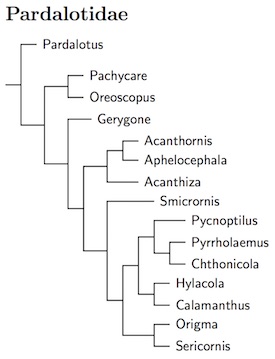
Pardalotidae: Pardalotes Strickland, 1842
1 genus, 4 species HBW-13
- Red-browed Pardalote, Pardalotus rubricatus
- Striated Pardalote, Pardalotus striatus
- Spotted Pardalote, Pardalotus punctatus
- Forty-spotted Pardalote, Pardalotus quadragintus
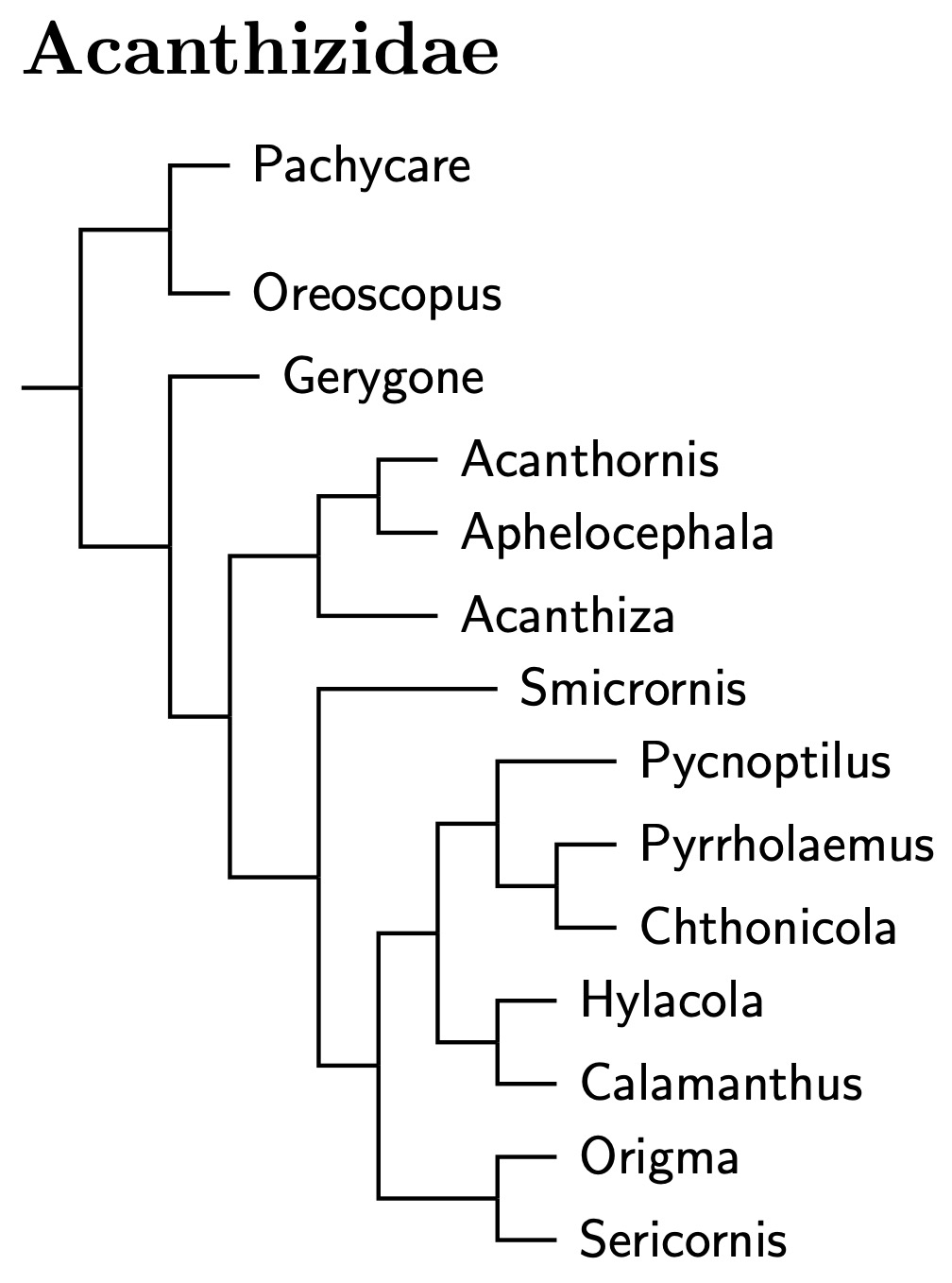
Acanthizidae: Gerygones, Thornbills, etc. Bonaparte, 1854
14 genera, 65 species
 |
| Click for species-level tree for Acanthizidae |
|---|
The Acanthizidae are primarily Australasian, with ranges east and south of Wallace's line. However, there is one exception—the Golden-bellied Gerygone. It ranges north to the Philippines and west to Malaysia and Sumatra.
Two papers by Norman et al. led to some adjustment of the family. Norman et al. (2009a) showed that the mohouas are not part of Pardalotidae, but rather belong in Corvoidea (in fact, they are a separate family there). In a second paper, Norman et al. (2009b) showed that the Goldenface, Pachycare flavogriseum, does belong in Pardalotidae, not Pachycephalidae, Petroicidae, or anyplace else that had previously been suggested.
The >Acanthizidae have been merged with the Pardalotidae in the TiF list. Traditionally, the differences between these taxa have been considered relatively small, with all of them sometimes placed in a single family with the bristlebirds. We now know that the bristlebirds do not belong in this group, but that the remainder form a natural group of broadly similar species. I think such a group is best treated as a single family, and the name Pardalotidae has priority.
Although early genetic results had suggested that the pardalotes were more closely related to the honeyeaters than to the gerygones and thornbills, that seems to be incorrect. E.g., Marki et al. (2017). Relatively complete analyses, such as Gardner et al. (2010), Jønsson et al. (2011b), and Nyári (2011) have found that the pardalotes form a clade with the former Acanthizidae. Marki et al. (2017) found a clade consisting of the pardalotes, Fernwren and Goldenface, and the former Acanthizidae. The divisions between the three parts are deep enough that each could be considered a separate family. I have opted to treat them as subfamilies within Pardalotidae.
There are two names that could apply to the Fernwren/Goldenface subfamily. Schodde and Christidis (2014) introduced the names Pachycareinae and Oreoscopinae. Since they did not give either priority over the other, a first reviser action is required to determine the correct name. I'm currently using Pachycareinae since it appears first in Schodde and Christidis. I don't treat them as separate subfamilies because Marki et al. (2017) found the division between them to be much shallower than the 3 deep divisions, which date back to 20-25 mya. In contrast, the Fernwren and Goldenface are probably separated by less than 15 million years.
It would not be unreasonable to divide the subfamily Acanthizinae into three tribes: Gerygonini (gerygones), Acanthizini (thornbills), Sericornithini (scrubwrens). The membership is rather obvious on either the genus or species tree and Marki et al. (2017) placed their common ancestors date back to around 15mya.
I originally developed the genus-level phylogenetic tree based on Gardner et al. (2010) and Nyári and Joseph (2012), with some help from Norman et al. (2009b), Nicholls et al. (2000), and Christidis et al. (1988). Subsequently, Marki et al. (2017) included all but one of the Pardalotidae in their analysis. The only change to the genus tree was the elimination of Crateroscelis. It was not a monophyletic group. The Rusty and Mountain Mouse-warblers have joined Origma and the Bicolored Mouse-warbler is now in Sericornis.
Christidis and Boles (2008) was also consulted during the process. I've decided to use their generic limits, putting the heathwrens in Hylacola and the Speckled Warbler in Chthonicola.
Acanthizidae: Species List
Pachycareinae: Goldenface and Fernwren Schodde and Christidis, 2014
- Goldenface, Pachycare flavogriseum
- Fernwren, Oreoscopus gutturalis
Acanthizinae: Gerygones, Thornbills, Scrubwrens Bonaparte, 1854
- Yellow-bellied Gerygone, Gerygone chrysogaster
- Brown Gerygone, Gerygone mouki
- Fairy Gerygone, Gerygone palpebrosa
- Green-backed Gerygone, Gerygone chloronota
- Plain Gerygone, Gerygone inornata
- Rufous-sided Gerygone, Gerygone dorsalis
- White-throated Gerygone, Gerygone olivacea
- Golden-bellied Gerygone, Gerygone sulphurea
- Dusky Gerygone, Gerygone tenebrosa
- Fan-tailed Gerygone, Gerygone flavolateralis
- Mangrove Gerygone, Gerygone levigaster
- Western Gerygone, Gerygone fusca
- Large-billed Gerygone, Gerygone magnirostris
- Biak Gerygone, Gerygone hypoxantha
- Brown-breasted Gerygone, Gerygone ruficollis
- Lord Howe Gerygone, Gerygone insularis
- Norfolk Gerygone, Gerygone modesta
- Gray Gerygone, Gerygone igata
- Chatham Gerygone, Gerygone albofrontata
- Scrubtit, Acanthornis magna
- Southern Whiteface, Aphelocephala leucopsis
- Banded Whiteface, Aphelocephala nigricincta
- Chestnut-breasted Whiteface, Aphelocephala pectoralis
- Yellow-rumped Thornbill, Acanthiza chrysorrhoa
- Gray Thornbill, Acanthiza cinerea
- New Guinea Thornbill, Acanthiza murina
- Yellow Thornbill, Acanthiza nana
- Striated Thornbill, Acanthiza lineata
- Inland Thornbill, Acanthiza apicalis
- Tasmanian Thornbill, Acanthiza ewingii
- Mountain Thornbill, Acanthiza katherina
- Brown Thornbill, Acanthiza pusilla
- Slender-billed Thornbill, Acanthiza iredalei
- Slaty-backed Thornbill, Acanthiza robustirostris
- Chestnut-rumped Thornbill, Acanthiza uropygialis
- Western Thornbill, Acanthiza inornata
- Buff-rumped Thornbill, Acanthiza reguloides
- Weebill, Smicrornis brevirostris
- Pilotbird, Pycnoptilus floccosus
- Redthroat, Pyrrholaemus brunneus
- Speckled Warbler, Chthonicola sagittatus
- Chestnut-rumped Heathwren, Hylacola pyrrhopygia
- Shy Heathwren, Hylacola cauta
- Striated Fieldwren, Calamanthus fuliginosus
- Rufous Fieldwren, Calamanthus campestris
- Western Fieldwren, Calamanthus montanellus
- Mountain Mouse-warbler, Origma robusta
- Rusty Mouse-warbler, Origma murina
- Rockwarbler, Origma solitaria
- Yellow-throated Scrubwren, Sericornis citreogularis
- Pale-billed Scrubwren, Sericornis spilodera
- Bicolored Mouse-warbler, Sericornis nigrorufus
- Gray-green Scrubwren, Sericornis arfakianus
- Papuan Scrubwren, Sericornis papuensis
- Vogelkop Scrubwren, Sericornis rufescens
- Buff-faced Scrubwren, Sericornis perspicillatus
- Tasmanian Scrubwren, Sericornis humilis
- White-browed Scrubwren, Sericornis frontalis
- Atherton Scrubwren, Sericornis keri
- Large-billed Scrubwren, Sericornis magnirostra
- Tropical Scrubwren, Sericornis beccarii
- Perplexing Scrubwren, Sericornis virgatus
- Large Scrubwren, Sericornis nouhuysi
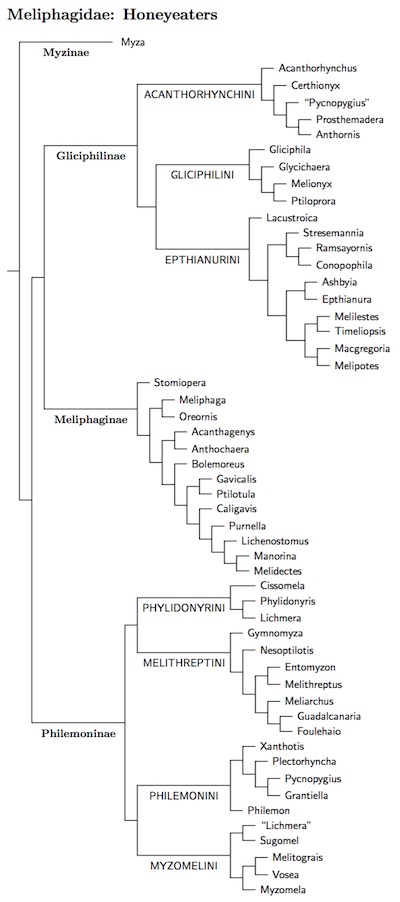
Meliphagidae: Honeyeaters Vigors, 1825
53 genera, 188 species HBW-13
 |
| Click for Meliphagidae species tree |
|---|
Although they have spread widely. The Meliphagidae are primarily Australasian. Some of them have colonized various islands in Oceania, and several have spread into Wallacea, including the Lesser Sundas, Moluccas, and Sulawesi, but only one occurs outside Australasia and Oceania. That is the Indonesian Honeyeater. It barely crosses Wallace's line into Bali, which is considered part of Indo-Malaya (aka the Oriental Region).
What is a Honeyeater?
As with many passerine families, one of the basic questions that DNA addresses is which species belong in the family. The honeyeaters have seen a number of changes. They were substantially restructured by Sibley and Ahlquist (1990), losing the genera Cleptornis (Passerida), Oedistoma and Toxorhamphus (Melanocharitidae), and Promerops (Promeropidae), but gaining Epthianura and Ashbyia from the defunct Epthianuridae. Sibley and Ahlquist's addition of the Epthianura and Ashbyia to the honeyeaters has been supported by the more recent studies of Driskell and Christidis (2004) and Nyári and Joseph (2011).
Spring et al. (1995) found that the Bonin Honeyeater, Apalopteron familiare is not a honeyeater, but rather belongs in the Passerida (more precisely, Zosteropidae). More recently, Cracraft and Feinstein (2000) found that MacGregor's Bird-of-paradise, Macgregoria pulchra, is actually a honeyeater, while Ewen et al. (2006) and Driskell et al. (2007) found that the Stitchbird, Notiomystis cincta belongs near the Callaeidae, where it becomes a monotypic family. The now-extinct Hawaiian honeyeaters (genera Moho and Chaetoptila) were formerly considered to be part of this family, but they have recently been found to be related to waxwings (Fleischer et al., 2008).
The composition of the honeyeater family is not all that needed to be sorted out. The phylogeny has also undergone some changes. The current understanding of honeyeater phylogeny was gradually built up from Driskell and Christidis (2004), Cracraft and Feinstein (2000), Norman et al. (2007), Higgins et al. (2008 = HBW-13), Gardner et al. (2010), Nyári and Joseph (2011), Andersen et al. (2014a), and Joseph et al. (2014a).
Then Marki et al. (2017) published an almost complete species-level phylogeny of the entire family. Their phylogeny has 9 major clades (treated as tribes) which I've arranged into 4 subfamilies. The arrangement of the tribes and subfamilies has been unstable in previous analyses. It is not clear that Marki et al. are the last word on this. Moyle et al.'s (2016) study using thousands of ultraconserved elements included honeyeaters from 4 tribes. The supplementary material made clear that different ways of analyzing the data yielded different honeyeater phylogenies. Perhaps the inclusion of so many taxa by Marki et al. (2017) has sorted this out.
Honeyeater Subfamiles
Joseph et al. (2014a) were the first authors to consider Myza. They found that the two Myzas form a basal clade, here called Myzinae. The Myzinae branch is quite deep and may date to the end of the Oligocene. Such old clades are often considered separate families. The rest of the honeyeaters fell into 3 major clades, also ranked here as subfamilies.
The next subfamily is Gliciphilinae. It also contains 3 tribes: Acanthorhynchini, Gliciphilini, and Epthianurini.
The two spinebills lead off (Acanthorhynchini). They seem to be most closely related to Prosthemaderini, which contains several New Zealand endemics. Although I had previously placed Pycnopygius in this group, it turns out that only two of its species belong here. The type species is the Streak-headed Honeyeater, Pycnopygius stictocephalus, which moves to Philimonini. That leaves the other two without a genus name, so they are "Pycnopygius" for now.
Note that Gliciphila has absorbed Glycifohia and that it belongs in Gliciphilini, sister to the Glycichaera/Ptiloprora clade (Andersen et al., 2014a). The Short-bearded Melidectes, Melidectes nouhuysi, and Long-bearded Melidectes, Melidectes princeps, do not belong in Melidectes (Meliphaginae). They have been separated as Melionyx which is sister to Ptiloprora.
Epthianurini contains the Australian Chats as well as various honeyeaters. The chats were once considered a separate family. The basal member of the tribe is the Gray Honeyeater, formerly Conopophila whitei. It has been placed in the monotypic genus Lacustroica as a result. In their study of MacGregor's “Bird-of-paradise”, Cracraft and Feinstein (2000) included representatives of four subfamilies. This was enough to show that Macgregoria is in the Epthianurinae. Joseph et al. (2014a) and Marki et al. (2017) confirmed it is sister to Melipotes.
The honeyeater clade Meliphaginae is next. Due to a deep genetic division found by Joseph et al. (2014a) and clarified by Marki et al. (2017), all but three Meliphaga have been moved to Oreornis (Van Oort 1910, type chrysogenys), even though all but the three streaked species (albilineatus, fordianus and reticulatus) are very similar to the three Meliphaga.
In Meliphagine the big news is the restructuring of Lichenostomus. Gardner et al. (2010) had shown that Lichenostomus was polyphyletic, even after removing Nesoptilotis. Nyári and Joseph (2011) carried out a complete analysis of Lichenostomus using the mitochondrial ND2 and nuclear β-fibrinogen-7 genes. Their results were generally consistent with Gardner et al. (2010), but revealed some additional surprises that require further dismemberment of Lichenostomus and the use of three more genera: Bolemoreus, Caligavis, and Stomiopera. The Bridled Honeyeater (frenatus) and Eungella Honeyeater (hindwoodi) turn out to be sister to the wattlebirds plus Acanthagenys. Nyári and Joseph (2011) created the new genus Bolemoreus (type frenata) to accomodate them.
The other pieces of the former Lichenostomus run in a grade from Pitlotula to the miners (Manorina). The first clade is divided into two genera. Singing through Mangrove Honeyeaters take the name Gavicalis (Schodde and Mason 1999, type virescens) while for the Gray-fronted through Yellow-tinted Honeyeaters, the name Ptilotula (Mathews 1912, type flavescens) has priority Paraptilotis (Mathews 1912, type fuscus) because Ptilotula was chosen as a subgenus name by Schodde and Mason (1999) in preference to Paraptilotis. Then come the White-gaped and Yellow Honeyeaters, for which the name Stomiopera is available (Reichenbach 1852, type unicolor). This group is followed by three more former Lichenostomus honeyeater, now placed in Caligavis (Iredale 1956, type obscura). The Lichenostomus grade is interrupted by Purnella albifrons, sometimes placed in Phylidonyris. Then we finally reach the remaining Lichenostomus, now reduced to two species.
This brings us to the final subfamily: Philemoninae. In the phylogeny based on Joseph et al. (2014a) and Marki et al. (2017) it consists of 4 tribes: Phylidonyrini, Melithreptini, Philemonini, and Myzomelini.
Phylidonyrini contains another former member of Certhionyx, the Banded Honeyeater, Cissomela pectoralis, as well as Phylidonyris (now including Trichodere) and Lichmera. Phylidonyrini is sister to Melithreptini.
Melithreptini leads off with two species that have been moved from Lichenostomus and placed in genus Nesoptilotis (Mathews 1913, type flavicollis): White-eared Honeyeater, Nesoptilotis leucotis, and Yellow-throated Honeyeater, Nesoptilotis flavicollis. These are rather different from the rest of the former Lichenostomus, so it's not surprising that they end up in a different genus. I had originally made this change based on Higgins et al. (2008) and Gardner et al. (2010), before DNA data was available for both species. It is also supported by the complete analysis of Lichenostomus of Nyári and Joseph (2011).
Based on Toon et al. (2010), Gilbert's Honeyeater, Melithreptus chloropsis has been split from White-naped Honeyeater, Melithreptus lunatus. They also found evidence that the White-throated Honeyeater, Melithreptus albogularis, may contain more than one species, but more study is necessary to clarify the situation.
Based on Andersen et al. (2014), Giant Honeyeater, Foulehaio viridis, has been split into Yellow-billed Honeyeater, Gymnomyza viridis, and Giant Honeyeater, Gymnomyza brunneirostris.
Following IOC 5.2, the English names of three Foulehaio honeyeaters have been changed:
- Viti Levu Honeyeater, Foulehaio procerior, becomes Kikau
- Vanua Levu Honeyeater, Foulehaio taviunensis, becomes Lesser Wattled-Honeyeater
- Polynesian Honeyeater, Foulehaio carunculatus, becomes Polynesian Wattled-Honeyeater
The next tribe is Philemonini, which contains the friarbirds and allied honeyeaters. The Hornbill Friarbird, Philemon yorki, has been split from Helmeted Friarbird, Philemon buceroides.
The last tribe is Myzomelini. It consists of Myzomela together with some small genera. The basal group consists of the monotypic Sugomel together with the Scaly-crowned Honeyeater, Lichmera lombokia. The latter, which is surprisingly not at all close to Lichmera, has been placed in the temporary genus "Lichmera". Although Sugomel nigrum has often been placed in Certhionyx, Driskell and Christidis (2004) showed this was mistaken.
Another surprise found by Marki et al. (2017) is that the White-streaked Friarbird, Melitograis gilolensis, does not belong with the other friarbirds. Rather it and the monotypic Vosea (Gilliard's Melidectes) are close to the myzomelas.
The myzomelas are arranged as in Marki et al. (2017). Based on their phylogeny, I have split the Moluccan Myzomela, Myzomela simplex, including rubrotincta and mortyana, from Dusky Myzomela, Myzomela obscura.
The Plain Honeyeater and Marbled Honeyeater have been moved from genus "Pycnopygius"" to Pinarostola Sangster et al. (2023c). They become Plain Honeyeater, Pinarostola ixoides, and Marbled Honeyeater, Pinarostola cinerea.
Myzinae: Myzas Informal
- Dark-eared Myza, Myza celebensis
- White-eared Myza, Myza sarasinorum
Gliciphilinae Reichenbach, 1882
Acanthorhynchini: Spinebills, NZ Bellbirds Mathews, 1946
- Western Spinebill, Acanthorhynchus superciliosus
- Eastern Spinebill, Acanthorhynchus tenuirostris
- Pied Honeyeater, Certhionyx variegatus
- Plain Honeyeater, Pinarostola ixoides
- Marbled Honeyeater, Pinarostola cinerea
- Tui / Parson Bird, Prosthemadera novaeseelandiae
- New Zealand Bellbird, Anthornis melanura
- Chatham Bellbird, Anthornis melanocephala
Gliciphilini Reichenbach, 1882
- Barred Honeyeater, Gliciphila undulata
- Tawny-crowned Honeyeater, Gliciphila melanops
- White-bellied Honeyeater, Gliciphila notabilis
- Green-backed Honeyeater, Glycichaera fallax
- Sooty Melidectes, Melionyx fuscus
- Short-bearded Melidectes, Melionyx nouhuysi
- Long-bearded Melidectes, Melionyx princeps
- Leaden Honeyeater, Ptiloprora plumbea
- Yellowish-streaked Honeyeater, Ptiloprora meekiana
- Rufous-sided Honeyeater, Ptiloprora erythropleura
- Gray-streaked Honeyeater, Ptiloprora perstriata
- Rufous-backed Honeyeater, Ptiloprora guisei
- Mayr's Honeyeater, Ptiloprora mayri
Epthianurini: Australian Chats & allies Legge, 1887
- Gray Honeyeater, Lacustroica whitei
- Bougainville Honeyeater, Stresemannia bougainvillei
- Brown-backed Honeyeater, Ramsayornis modestus
- Bar-breasted Honeyeater, Ramsayornis fasciatus
- Rufous-banded Honeyeater, Conopophila albogularis
- Rufous-throated Honeyeater, Conopophila rufogularis
- Gibberbird, Ashbyia lovensis
- Yellow Chat, Epthianura crocea
- Crimson Chat, Epthianura tricolor
- White-fronted Chat, Epthianura albifrons
- Orange Chat, Epthianura aurifrons
- Long-billed Honeyeater, Melilestes megarhynchus
- Tawny Straightbill, Timeliopsis griseigula
- Olive Straightbill, Timeliopsis fulvigula
- MacGregor's Honeyeater, Macgregoria pulchra
- Spangled Honeyeater, Melipotes ater
- Arfak Honeyeater, Melipotes gymnops
- Common Smoky-Honeyeater, Melipotes fumigatus
- Wattled Smoky-Honeyeater, Melipotes carolae
Meliphaginae: Honeyeaters, Wattlebirds, Miners Vigors, 1825
Meliphagini: Honeyeaters, Wattlebirds, Miners Vigors, 1825
- White-gaped Honeyeater, Stomiopera unicolor
- Yellow Honeyeater, Stomiopera flava
- Puff-backed Honeyeater, Meliphaga aruensis
- Yellow-spotted Honeyeater, Meliphaga notata
- Lewin's Honeyeater, Meliphaga lewinii
- Streak-breasted Honeyeater, Oreornis reticulatus
- Kimberley Honeyeater, Oreornis fordianus
- White-lined Honeyeater, Oreornis albilineatus
- Yellow-gaped Honeyeater, Oreornis flavirictus
- Orange-cheeked Honeyeater, Oreornis chrysogenys
- Tagula Honeyeater, Oreornis vicinus
- Forest Honeyeater, Oreornis montanus
- Mottle-breasted Honeyeater, Oreornis mimikae
- Elegant Honeyeater, Oreornis cinereifrons
- Mountain Honeyeater, Oreornis orientalis
- Mimic Honeyeater, Oreornis analogus
- Scrub Honeyeater, Oreornis albonotatus
- Graceful Honeyeater, Oreornis gracilis
- Spiny-cheeked Honeyeater, Acanthagenys rufogularis
- Western Wattlebird, Anthochaera lunulata
- Little Wattlebird, Anthochaera chrysoptera
- Regent Honeyeater, Anthochaera phrygia
- Red Wattlebird, Anthochaera carunculata
- Yellow Wattlebird, Anthochaera paradoxa
- Bridled Honeyeater, Bolemoreus frenatus
- Eungella Honeyeater, Bolemoreus hindwoodi
- Varied Honeyeater, Gavicalis versicolor
- Singing Honeyeater, Gavicalis virescens
- Mangrove Honeyeater, Gavicalis fasciogularis
- White-plumed Honeyeater, Ptilotula penicillata
- Yellow-plumed Honeyeater, Ptilotula ornata
- Gray-headed Honeyeater, Ptilotula keartlandi
- Gray-fronted Honeyeater, Ptilotula plumula
- Yellow-tinted Honeyeater, Ptilotula flavescens
- Fuscous Honeyeater, Ptilotula fusca
- Yellow-faced Honeyeater, Caligavis chrysops
- Obscure Honeyeater, Caligavis obscura
- Black-throated Honeyeater, Caligavis subfrenata
- White-fronted Honeyeater, Purnella albifrons
- Purple-gaped Honeyeater, Lichenostomus cratitius
- Yellow-tufted Honeyeater, Lichenostomus melanops
- Bell Miner, Manorina melanophrys
- Noisy Miner, Manorina melanocephala
- Yellow-throated Miner, Manorina flavigula
- Black-eared Miner, Manorina melanotis
- Ornate Melidectes, Melidectes torquatus
- Vogelkop Melidectes, Melidectes leucostephes
- Cinnamon-browed Melidectes, Melidectes ochromelas
- Belford's Melidectes, Melidectes belfordi
- Yellow-browed Melidectes, Melidectes rufocrissalis
- Huon Melidectes, Melidectes foersteri
Philemoninae: Friarbirds & allies Lesson, 1828
Phylidonyrini Mathews, 1946
- Banded Honeyeater, Cissomela pectoralis
- Crescent Honeyeater, Phylidonyris pyrrhopterus
- White-streaked Honeyeater, Phylidonyris cockerelli
- White-cheeked Honeyeater, Phylidonyris niger
- New Holland Honeyeater, Phylidonyris novaehollandiae
- Flame-eared Honeyeater, Lichmera flavicans
- Black-necklaced Honeyeater, Lichmera notabilis
- Scaly-breasted Honeyeater, Lichmera squamata
- Silver-eared Honeyeater, Lichmera alboauricularis
- Gray-eared Honeyeater, Lichmera incana
- Indonesian Honeyeater, Lichmera limbata
- Brown Honeyeater, Lichmera indistincta
- Olive Honeyeater, Lichmera argentauris
- Buru Honeyeater, Lichmera deningeri
- Seram Honeyeater, Lichmera monticola
Melithreptini G.R. Gray, 1841
- Crow Honeyeater, Gymnomyza aubryana
- White-eared Honeyeater, Nesoptilotis leucotis
- Yellow-throated Honeyeater, Nesoptilotis flavicollis
- Blue-faced Honeyeater, Entomyzon cyanotis
- Gilbert's Honeyeater, Melithreptus chloropsis
- White-naped Honeyeater, Melithreptus lunatus
- Black-headed Honeyeater, Melithreptus affinis
- White-throated Honeyeater, Melithreptus albogularis
- Strong-billed Honeyeater, Melithreptus validirostris
- Black-chinned Honeyeater, Melithreptus gularis
- Brown-headed Honeyeater, Melithreptus brevirostris
- Makira Honeyeater, Meliarchus sclateri
- Guadalcanal Honeyeater, Guadalcanaria inexpectata
- Giant Honeyeater, Foulehaio brunneirostris
- Yellow-billed Honeyeater, Foulehaio viridis
- Kadavu Honeyeater, Foulehaio provocator
- Mao, Foulehaio samoensis
- Kikau Honeyeater, Foulehaio procerior
- Fiji Wattled-Honeyeater, Foulehaio taviunensis
- Polynesian Wattled-Honeyeater, Foulehaio carunculatus
Philemonini: Friarbirds & allies Lesson, 1828
- Spotted Honeyeater, Xanthotis polygrammus
- Macleay's Honeyeater, Xanthotis macleayanus
- Tawny-breasted Honeyeater, Xanthotis flaviventer
- Striped Honeyeater, Plectorhyncha lanceolata
- Streak-headed Honeyeater, Pycnopygius stictocephalus
- Painted Honeyeater, Grantiella picta
- Brass's Friarbird, Philemon brassi
- Timor Friarbird, Philemon inornatus
- Gray Friarbird, Philemon kisserensis
- Little Friarbird, Philemon citreogularis
- Meyer's Friarbird, Philemon meyeri
- Dusky Friarbird, Philemon fuscicapillus
- Manus Friarbird, Philemon albitorques
- New Ireland Friarbird, Philemon eichhorni
- New Britain Friarbird, Philemon cockerelli
- Tanimbar Friarbird, Philemon plumigenis
- Helmeted Friarbird, Philemon buceroides
- New Guinea Friarbird, Philemon novaeguineae
- Hornbill Friarbird, Philemon yorki
- Silver-crowned Friarbird, Philemon argenticeps
- Noisy Friarbird, Philemon corniculatus
- New Caledonian Friarbird, Philemon diemenensis
- Black-faced Friarbird, Philemon moluccensis
- Seram Friarbird, Philemon subcorniculatus
Myzomelini: Myzomela & allies G.R. Gray, 1840
- Scaly-crowned Honeyeater, "Lichmera" lombokia
- Black Honeyeater, Sugomel nigrum
- White-streaked Friarbird, Melitograis gilolensis
- Bismarck Honeyeater / Gilliard's Melidectes, Vosea whitemanensis
- Red-collared Myzomela, Myzomela rosenbergii
- Ruby-throated Myzomela, Myzomela eques
- Ashy Myzomela, Myzomela cineracea
- Dusky Myzomela, Myzomela obscura
- White-chinned Myzomela, Myzomela albigula
- Black-bellied Myzomela, Myzomela erythromelas
- Drab Myzomela, Myzomela blasii
- Moluccan Myzomela, Myzomela simplex
- Red Myzomela, Myzomela cruentata
- Crimson-hooded Myzomela, Myzomela kuehni
- Papuan Black Myzomela, Myzomela nigrita
- Black-breasted Myzomela, Myzomela vulnerata
- Red-headed Myzomela, Myzomela erythrocephala
- Sumba Myzomela, Myzomela dammermani
- Mountain Myzomela, Myzomela adolphinae
- Sulawesi Myzomela, Myzomela chloroptera
- Wakolo Myzomela, Myzomela wakoloensis
- Banda Myzomela, Myzomela boiei
- Scarlet Myzomela, Myzomela sanguinolenta
- New Caledonian Myzomela, Myzomela caledonica
- Micronesian Myzomela, Myzomela rubratra
- Rotuma Myzomela, Myzomela chermesina
- Sooty Myzomela, Myzomela tristrami
- Cardinal Myzomela, Myzomela cardinalis
- Crimson-rumped Myzomela, Myzomela eichhorni
- Sulphur-breasted Myzomela, Myzomela jugularis
- New Ireland Myzomela, Myzomela pulchella
- Red-vested Myzomela, Myzomela malaitae
- Bismarck Black Myzomela, Myzomela pammelaena
- Sclater's Myzomela, Myzomela sclateri
- Red-capped Myzomela, Myzomela lafargei
- Black-headed Myzomela, Myzomela melanocephala
Orthonychida Informal
The last two basal oscine families are the logrunners (Orthonychidae) and Australasian babblers (Pomatostomidae). The massive multigene analysis of Aggerbeck et al. (2014) finds them to be sisters, albeit fairly deeply separated. They split off around 32.1 mya, less than a million years before the division between the Corvida and Passerida at 31.2 mya. That makes them basal oscines.
Orthonychidae: Logrunners G.R. Gray, 1840
1 genus, 3 species HBW-12
The logrunners are found in Australia and New Guinea.
- Papuan Logrunner, Orthonyx novaeguineae
- Australian Logrunner, Orthonyx temminckii
- Chowchilla, Orthonyx spaldingii
Pomatostomidae: Australasian Babblers Schodde, 1975
2 genera, 5 species HBW-12
As befits their name, the Australasian babblers are found in both Australia and New Guinea.
- Papuan Babbler, Garritornis isidorei
- Gray-crowned Babbler, Pomatostomus temporalis
- Hall's Babbler, Pomatostomus halli
- White-browed Babbler, Pomatostomus superciliosus
- Chestnut-crowned Babbler, Pomatostomus ruficeps